Dizziness remaining after treatment
If you still feel floaty or unsteady after a canalith repositioning procedure
Rather than vaguely waiting for the dizziness remaining after the repositioning procedure to fade, we distinguish between the recurrence of the spinning sensation, the actual movement ladder, and tension in the neck and body to design Korean herbal medicine treatment and balance recovery together.
The feeling of the room spinning when turning your head may have disappeared, but you may still feel floaty or unsteady when walking or looking at a screen. BPPVWe must first distinguish whether the symptoms have persisted as they were, or if the balance system is in the process of adapting to a new state.
Distinguish whether the spinning sensation returns or if a continuous floating feeling persists
Canalith repositioning procedureEven after successful treatment, you may experience residual dizziness for several days to weeks, such as a lack of mental clarity or a feeling that the floor is undulating. A strong spinning sensation lasting around several dozen seconds in specific positions is not the same as non-rotational discomfort that continues while walking or standing.
If the same spinning sensation is clearly reproduced when lying down or turning over, we re-verify if otoconia remain or have entered another semicircular canal. If the spinning has stopped but only a floating feeling remains, rather than repeatedly performing the canalith repositioning procedure, we must examine the balance system's adaptation, neck tension, visual dependence, and the body's recovery capacity.
The eyes and feet need time to regain their balance
After the balance information from the ear changes, the brain recalibrates the sensations coming from the eyes, joints, and the soles of the feet. During this process, turning your head quickly, viewing screens with moving complex patterns, or being in supermarket aisles and crowded streets may feel exceptionally dizzying.
Avoiding all movement due to anxiety may feel comfortable in the short term, but it reduces the opportunity for the balance system to adapt. Recover daily movements by walking for short periods within a range where there is no risk of falling, and slowly shifting your gaze between near and far points. The key is to increase activity gradually, provided that dizziness does not spike significantly.
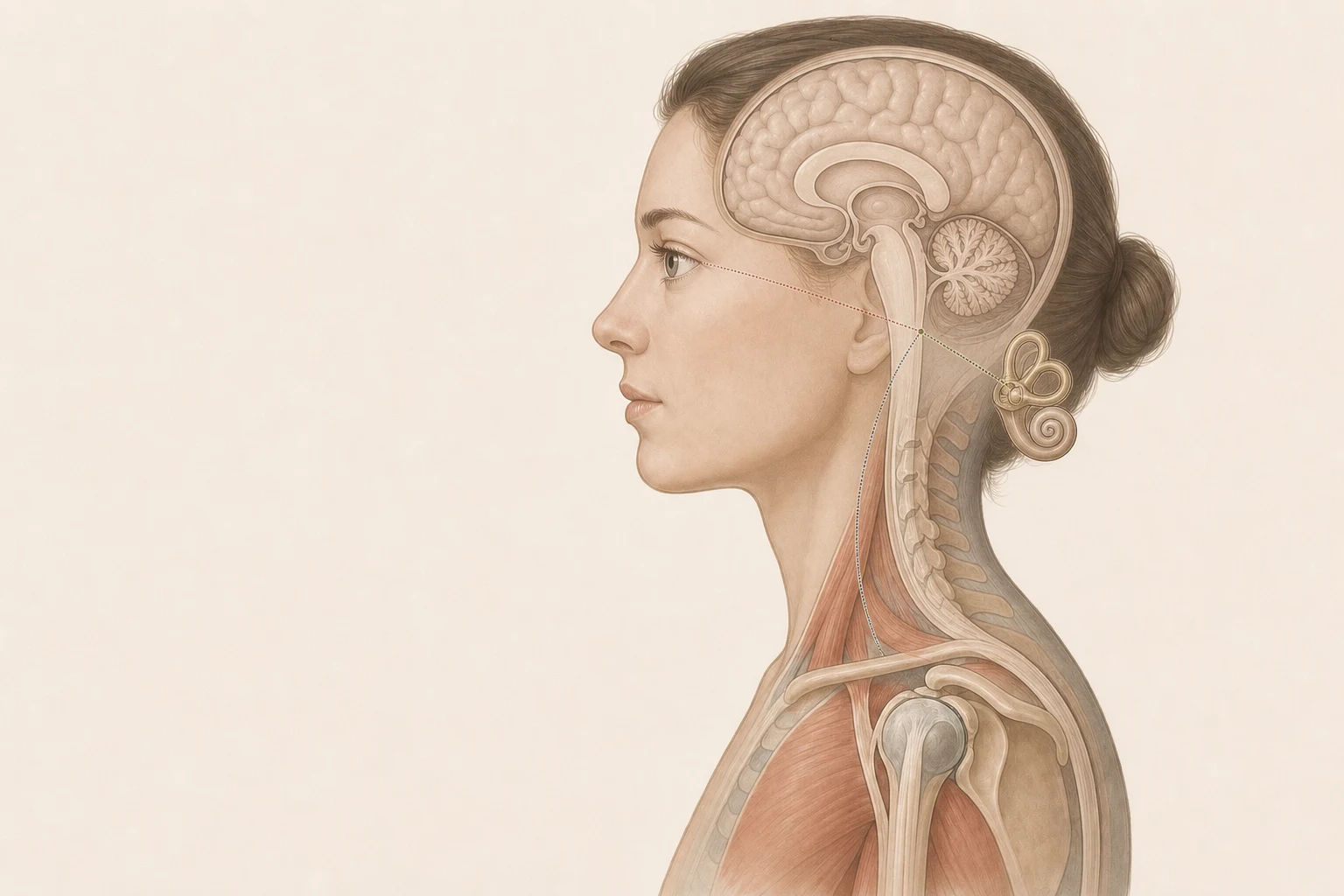
Balance is maintained not only by information from the ears but by processing visual, vestibular, and somatic sensory information together.
Stiffness in the neck and breathing can cause instability to linger longer
Walking while keeping the head fixed for fear of the spinning returning can lead to stiffness in the neck and shoulders and shallow breathing. This makes the sensations received when moving the head feel more unfamiliar, and combined with headaches and eye fatigue, even small vibrations can feel significant.
Instead of walking with your chin tucked and your whole body tense, keep your gaze forward, lower your shoulders, and move at a comfortable pace. Rather than just lowering screen brightness, incorporate time to look far away after short periods of screen use. Recovery is shown by what movements you can perform again, rather than measuring symptoms all day.
Korean herbal medicine treatment addresses the diminished recovery capacity following dizziness
Some patients find that while the spinning sensation has decreased after the canalith repositioning procedure, they feel drained, have brain fog, and experience instability in appetite and sleep. Conversely, others may experience a racing heart and heat rising to the upper body, with the body becoming excessively tense even at small movements. Even with the same residual dizziness, the remaining bodily reactions differ.
Baekrokdam prescribes Korean herbal medicine by distinguishing whether the head is heavy and nauseous due to phlegm-fluid (dam-eum), whether recovery after walking is slow due to deficiency of qi and blood, or whether the eyes and head fatigue easily due to tension and heat rising upward. Acupuncture treatment is provided concurrently to release the stiff neck and chest and to lower the body's tension in accepting balance stimuli.
Recovery is measured by the range of movement regained, rather than reaching 0 points of dizziness
If you can go out alone even with some residual dizziness, recover after a short break from a screen, and your body does not freeze when turning your head, your balance system is recovering. Conversely, even if the intensity of symptoms is weak, if you continue to avoid driving, grocery shopping, or stairs, functional recovery must be addressed more actively.
If new symptoms that were not present before occur Residual Dizzinessdo not simply dismiss them; first undergo a re-evaluation. If it is not a recurrence, we will continue the necessary balance rehabilitation and determine which of the following, decreased energy, nausea, neck tension, or poor sleep, should be addressed together through Baekrokdam treatment.
Recovery is expanded like a ladder, from rotating in bed to viewing screens and going outdoors
Even if residual dizziness improves, not all movements may become comfortable overnight. It is more practical to gradually expand your activity, starting with rolling over and getting up, then turning your head and walking indoors, and finally looking at screens or facing complex stimuli like supermarkets and vehicles, to identify exactly where you are still struggling.
If rolling over in bed remains difficult, the focus shifts toward re-evaluation; however, if there is no spinning sensation but you feel unstable only when looking at screens, in supermarkets, or in vehicles, the focus shifts toward residual dizziness and visual sensitivity, Vestibular Rehabilitationthe proportion of which increases. If your walking has improved but neck tension and a feeling of grogginess the next day persist, we determine the specific scope for acupuncture and herbal medicine treatment during your Baekrokdam consultation. By distinguishing the stage for checking recurrence from the stage for expanding the range of recovery on a single 'recovery ladder,' the next step becomes clear.
- Rolling over and getting up in bed
- Turning the head and walking indoors
- Looking at screens for short periods and short outings
- Expanding stages to complex stimuli such as supermarkets and vehicles
After the canalith repositioning procedure, we first distinguish between the recurrence of the same spinning sensation and a floating residual dizziness. After checking for recurrence, we use a recovery ladder, progressing from bed rotation, head turning, walking, screens, supermarkets, and vehicles, to divide the roles of vestibular rehabilitation and Baekrokdam treatment.
Evidence and Update Information
This content was organized by Korean medicine doctor Choi Yeon-seung based on the materials below and was updated on 2026-09-03.
- NIDCD: Ménière’s DiseaseConnection between episodic dizziness and hearing loss, tinnitus, and ear fullness
- NIDCD: Sudden DeafnessEmergency evaluation boundaries for sudden unilateral hearing changes
- NIDCD: TinnitusBasic information for assessing tinnitus hearing, sound characteristics, and daily burden
- NICE: Tinnitus: assessment and managementEvaluation and referral criteria for distinguishing hearing changes, pulsating patterns, and life impact in tinnitus
- AAO-HNSF: BPPV clinical practice guideline updatePositional testing, canalith repositioning procedure, re-evaluation, and residual symptom management criteria for BPPV
- NHS: Ménière’s diseaseEpisodic combinations of dizziness, hearing loss, tinnitus, and ear pressure, and daily safety guidelines
- Bárány Society: Vestibular neuritis criteriaDiagnostic criteria for acute persistent vestibular syndrome and vestibular neuritis, and symptoms to observe when distinguishing central causes
- NIDCD: Balance DisordersSensations of dizziness and imbalance: Basic pathways for equilibrium system evaluation and rehabilitation
- Bárány Society: Classification of vestibular symptomsCriteria for verbally distinguishing between vertigo, non-rotational dizziness, and symptoms triggered by posture or vision
- NICE: Suspected neurological conditionsCriteria for prioritizing neurological evaluation in cases of dizziness accompanied by new gait disturbances, speech difficulties, or one-sided weakness.