Sensation of dizziness
What is the difference between spinning dizziness, a floating sensation, and feeling faint?
While a sensation alone cannot determine a diagnosis, sharing the duration along with posture, head movement, visual stimuli, and pulsating sensations makes the direction of examinations and Korean medicine treatment much clearer.
A spinning sensation where the world rotates, imbalance where the body feels floating or unsteady, and a pre-syncope feeling where vision goes dark are all expressed as 'dizziness,' but the bodily axes involved are different.
| Sensation | What to record together | Points to check first |
|---|---|---|
| Spinning sensation (vertigo) | Head position and duration | BPPV or vestibular causes |
| Floating and staggering | Changes during walking, looking at screens, or in supermarkets | Persistence and visually induced dizziness |
| Vision going dark and loss of strength | Timing of standing up, pulse, and cold sweats | Orthostatic, Cardiac, and Pre-syncope Stages |
The words used to describe dizziness are not a diagnosis, but the first map to finding the cause
Not everyone who says they feel like they are 'spinning' BPPVhas the same condition, and not everyone who says they feel 'floaty' has an autonomic nervous system issue. However, the system we check first differs depending on whether the world spins for a few seconds when turning the head, whether a spinning sensation lasts for tens of minutes even while still, or whether vision blurs and you feel like collapsing while standing.
More important than the feeling itself are the duration and the triggering scenarios. Depending on whether it lasts for a few seconds or several hours, whether it occurs when changing head position or when standing up, and whether it worsens in visually complex environments like supermarkets or screens, we differentiate between the ear's balance system,Migraineblood pressure and circulation, or the possibility of persistent dizziness.
A spinning sensation occurs when the ears and the brain interpret movement differently
If there is intense spinning that lasts from a few seconds to about 1 minute when rolling over in bed or lifting the head, it is close to a typical scenario of BPPV (benign paroxysmal positional vertigo). If it lasts from tens of minutes to several hours and is accompanied by ear fullness, tinnitus, or changes in hearing, Meniere's diseasewe consider other causes; if you are sensitive to light and sound and experience worsened motion sickness even without a headache, we also look for vestibular migraine.
If a sudden, strong spinning sensation persists and is accompanied by difficulty walking, slurred speech, or weakness on one side of the body, we do not wait and assume it is only an ear problem. After receiving the necessary acute evaluation, if nausea, shakiness, or instability when moving the head remains, you can continue with vestibular recovery and Korean medicine treatment.
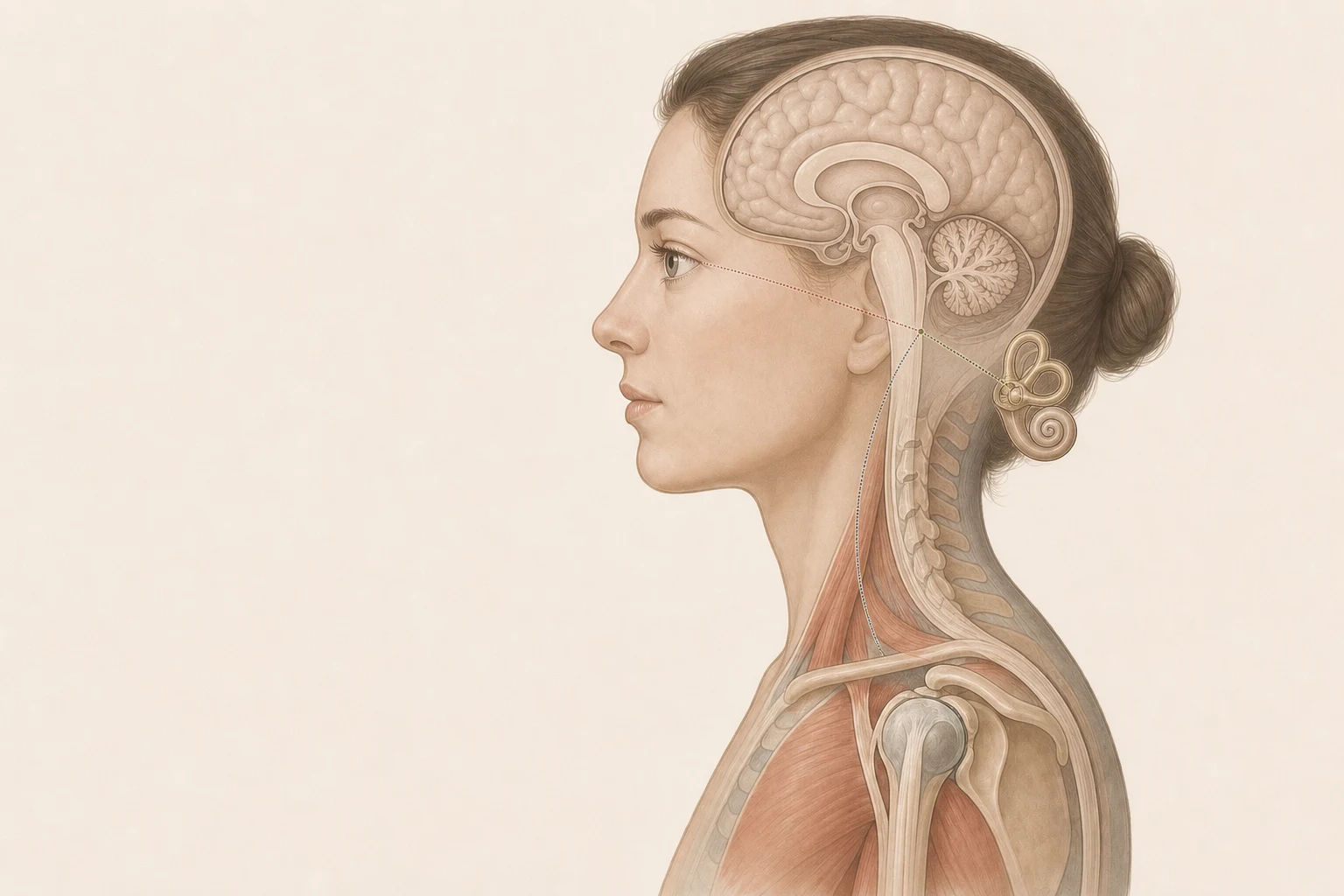
Balance is maintained not only by information from the ears but by processing visual, vestibular, and somatic sensory information together.
A floaty or staggering feeling is evaluated based on the burden of movement and vision
Feelings of the floor shaking, walking on clouds, or losing balance when turning the head quickly or walking can remain during the recovery phase after an acute vestibular disorder. If these symptoms worsen at supermarket shelves, while scrolling through screens, or looking out a fast-moving car window, we consider visually induced dizziness, where the visual movement does not match the body's balance information.
This type of dizziness is more prominent when standing or walking than when lying still, and it can last longer when accompanied by anxiety and neck tension. Rather than repeatedly being told that tests are normal, we must find the parts of the body that failed to relearn balance after the event that first caused the dizziness.
If vision goes dark and strength fades, we look for pre-syncope reactions
If vision blurs and you experience cold sweats, nausea,pulsatingand other symptoms when rising from a lying position, standing for a long time, being in a hot place, or after a meal, and these subside upon sitting or lying down, we examine for orthostatic blood pressure changes, postural tachycardia, or pre-syncope reactions of the vagus nerve. This feeling has a different starting point than the spinning sensation of BPPV that occurs when turning the head.
Anemia, dehydration, bleeding, hypoglycemia, arrhythmia, and certain medications can create similar scenarios. In particular, if these occur during exercise or are accompanied by actual fainting, chest pain, or shortness of breath, Autonomic nerveswe verify cardiac and circulatory causes before grouping them under the term ataxia.
Korean medicine treatment addresses both the underlying cause of dizziness and the speed of recovery
At Baekrokdam, we prescribe Korean herbal medicine by categorizing the systemic flow accompanying dizziness: 'Dam-eum' (phlegm-fluid) where the head feels heavy and nauseous and fluctuates according to weather and digestion; 'Qi and Blood Deficiency' where energy is low, one feels dizzy when standing, and finds it difficult to stand for long; and 'Upper Heat' and hyperarousal, characterized by heat sensations, pulsating, insomnia, and a floating feeling. Even for the same 'floaty feeling,' the treatment differs for someone who feels heavy due to internal blockage versus someone who feels floaty due to a lack of strength.
Acupuncture treatment reduces excessive tension around the neck and head, lowers sensitivity to balance stimuli, and helps the body readapt to movement. In cases where a canalith repositioning procedure, vestibular rehabilitation, or cardiac/neurological treatment is necessary, we continue those while using Korean medicine treatment to manage symptoms that hinder recovery, such as nausea, insomnia, and decreased energy.
Recovery is seen when the range of movements you avoid due to dizziness decreases
After the acute phase, avoiding all movement and lying down for too long can cause the balance system to lose its chance to adapt. Gradually recover activities such as turning the head and walking within a range where there is no risk of falling; however, those with pre-syncope feelings should not push themselves but should sit or lie down first to ensure safety. Movement must be appropriate for the cause.
When treatment is effective, it is not just the peak intensity of dizziness that decreases. The time it takes for the sensation to subside after turning the head becomes shorter, the time you can endure in supermarkets and vehicles increases, and the dizziness and pulsating when rising in the morning diminish. Actual recovery is being able to walk, work, and go out alone again.
A spinning sensation, a floating feeling of imbalance, and a feeling of near-fainting where everything goes dark all have different origins; depending on the duration and the triggering situation, the required tests and the goals of Korean medicine treatment will differ.
Evidence and Update Information
This content was organized by Korean medicine doctor Choi Yeon-seung based on the materials below and was updated on 2026-08-31.
- NIDCD: Balance DisordersSensations of dizziness and imbalance: Basic pathways for equilibrium system evaluation and rehabilitation
- Bárány Society: Classification of vestibular symptomsCriteria for verbally distinguishing between vertigo, non-rotational dizziness, and symptoms triggered by posture or vision
- NICE: Suspected neurological conditionsCriteria for prioritizing neurological evaluation in cases of dizziness accompanied by new gait disturbances, speech difficulties, or one-sided weakness.
- AAFP: Dizziness: Evaluation and ManagementA primary care approach to categorizing dizziness by onset timing, duration, and clinical findings.
- MedlinePlus: Dizziness and VertigoPatient guidance on rotational sensations, imbalance, feelings of near-fainting, and accompanying symptoms that require medical attention.
- JAMA: Approach to dizzinessA review for differentiating dizziness by focusing on the timing and triggering factors rather than the patient's description of symptoms.
- NHS: DizzinessPatient criteria explaining persistent or recurring dizziness and symptoms that require prompt medical evaluation.