Dizziness after vestibular neuritis: Read in the order of your curiosity
Before grouping symptoms under a single name
After vestibular neuritis, recovering your gait and vision may take longer than recovering from the spinning sensation
Vestibular neuritisinvolves the sudden onset of severe vertigo, where the surroundings feel as if they are constantly spinning. This may be accompanied by a tendency to lean to one side, difficulty walking, nausea, and vomiting. While moving the head increases discomfort, unlike BPPV (benign paroxysmal positional vertigo) which occurs briefly only in specific positions, symptoms may persist even while staying still in the early stages. Typically, there is no new hearing loss or tinnitus; if auditory symptoms are present, other causes such as labyrinthitis are evaluated.
Categorizing Symptoms
Distinguish by duration, auditory changes, and sudden neurological symptoms
Dizziness that appears similar is categorized by symptom clusters.
| Observed Symptoms | Possible Meaning | Action to Take Now |
|---|---|---|
| Sudden persistent vertigo, unstable gait | Possible decline in vestibular nerve function | Evaluation of cause via same-day medical evaluation |
| Dizziness with new hearing loss or tinnitus | Differential diagnosis for labyrinthitis or auditory system diseases | ENT hearing evaluation |
| Brief vertigo only when changing positions | Possible positional vertigo, such as BPPV | Positional test consultation |
| Paralysis, double vision, slurred speech, severe headache | Possible central causes such as stroke | Immediate emergency evaluation |
When to seek medical attention first
Symptoms that require immediate attention in vestibular neuritis
The following changes require checking for emergency causes, such as stroke, first.
- Sudden weakness or numbness in one side of the face, arms, or legs
- Slurred speech, double vision, or difficulty swallowing
- Accompanied by new and very severe headache, fainting, or confusion
- Difficulty standing alone or repeated vomiting to the point of being unable to drink water
Recovery period after acute vertigo has passed
If gait and gaze do not return to normal even after vestibular neuritis treatment
Acute vestibular neuritis requires initial medical evaluation to first distinguish it from stroke and sudden hearing changes. During the period when recovery is slow, where the field of vision jumps when turning the head, or you feel unsteady on dark roads, in supermarkets, or while looking at screens even after vertigo has decreased, we check both rehabilitation and overall systemic recovery.
Dividing the acute phase and the compensatory recovery phase
We distinguish whether severe vertigo and vomiting remain, or if imbalance and visual instability occur only during movement.
Checking if lack of movement is delaying recovery
We review medical records to check if you stayed only in bed while avoiding safe-range vestibular rehabilitation, and the duration of use of symptom-suppressing medications.
Checking sleep, digestion, and energy levels that may hinder recovery
We examine whether it is difficult to continue training and walking due to decreased food intake after vomiting, shallow sleep, or a sense of exhaustion.
Treatment GoalRather than replacing vestibular rehabilitation, we expand the tolerance for gaze and gait training to accelerate the return to screen use, outings, and work.
Consult about vestibular recovery period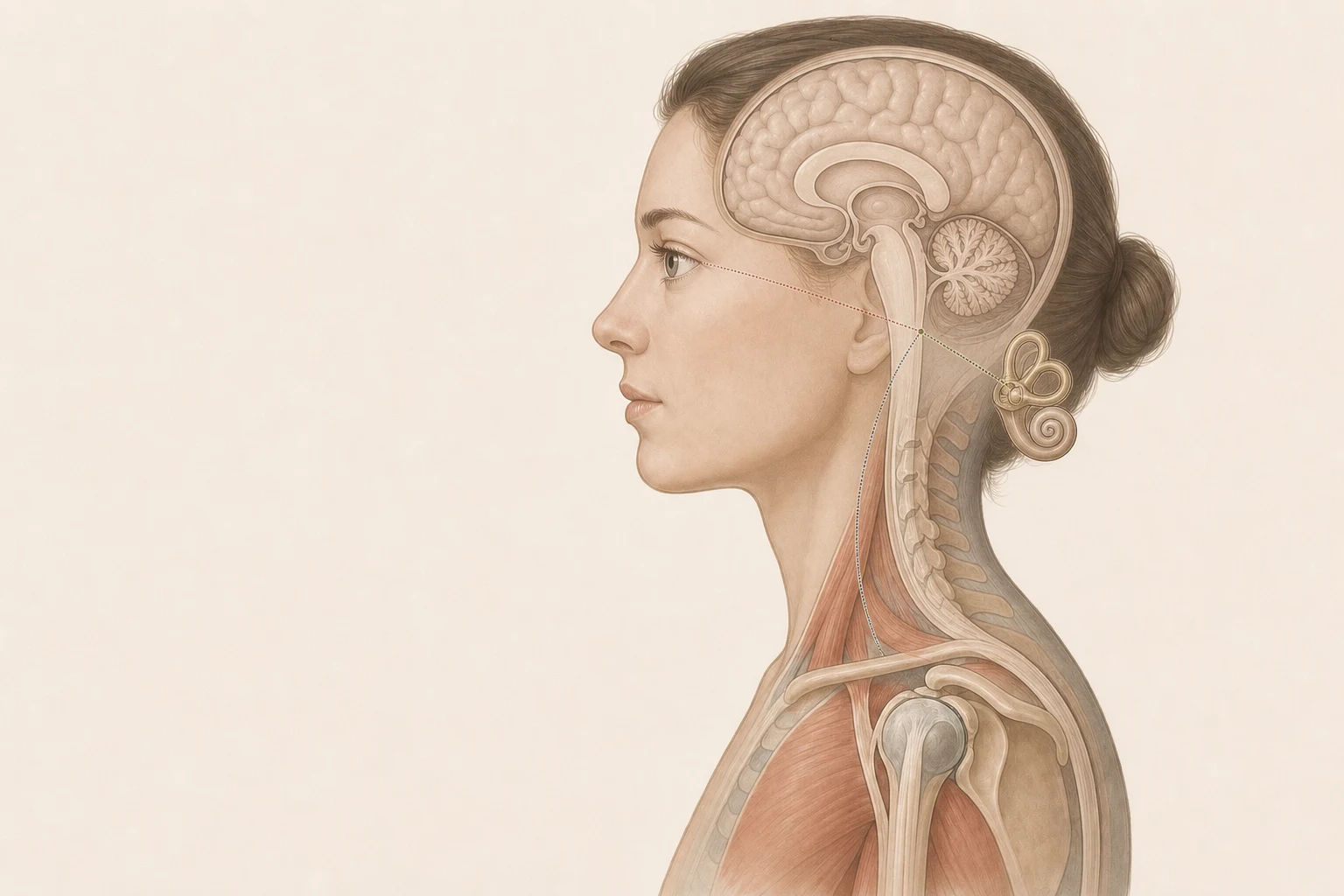
Balance is maintained not only by information from the ears but by processing visual, vestibular, and somatic sensory information together.
Photos show daily life scenes where symptoms appear, and explanatory diagrams simplify how reactions in the ears, balance, nerves, and the entire body are connected. They do not represent an individual's diagnostic or treatment results.If you have had these experiences
If gait and gaze do not return to normal even after treatment for vestibular neuritis
The acute phase vertigomay have passed, but some experience visual instability when walking or quickly become exhausted in front of screens or in crowded places. While continuing vestibular rehabilitation, we simultaneously check for physical burdens that hinder recovery.
Those whose gaze shakes when turning the head or walking even after acute phase treatment
When the sensation of spinning has decreased after acute evaluation and treatment, but discomfort in gait and gaze persists for a long time
Those who find it difficult to be consistent because nausea and fatigue persist long after rehabilitation exercises
Vestibular RehabilitationWhen performing these exercises leads to severe exhaustion and nausea that lasts until the next day
Those whose return to work has been delayed due to avoiding screens, supermarkets, or public transportation
When it is difficult to consistently continue recovery training due to declines in sleep, appetite, or energy
This is how we approach the medical evaluation
Dizziness after vestibular neuritis: the sequence of symptom onset and symptoms to check first
Acute vestibular neuritis must first be distinguished from stroke and sudden hearing changes before receiving initial medical evaluation. During periods of slow recovery, where the visual field jumps when turning the head or instability occurs on dark roads, in supermarkets, or in front of screens even after the spinning sensation has decreased, we evaluate both rehabilitation and systemic recovery.
Dividing the acute phase and the compensatory recovery phase
We distinguish whether severe spinning sensations and vomiting remain, or if imbalance and visual instability appear only during movement.
Checking if inactivity is delaying recovery
We review medical records to check if the patient remained only in bed while avoiding safe-range vestibular rehabilitation, and the duration of use of symptom-suppressing medications.
Evaluating sleep, digestion, and energy that deplete recovery
We examine whether it is difficult to continue training and walking due to decreased food intake after vomiting, shallow sleep, or a sense of lethargy.
Reasons why it may not heal easily
Physical conditions that accompany long-lasting dizziness after vestibular neuritis
Acute vestibular neuritis must first be distinguished from stroke and sudden hearing changes before receiving initial medical evaluation. During periods of slow recovery, where the visual field jumps when turning the head or instability occurs on dark roads, in supermarkets, or in front of screens even after the spinning sensation has decreased, we evaluate both rehabilitation and systemic recovery.
Separating the first 10 minutes from the following day
Record the exact time when the strong sensation of spinning stopped, as well as when your walking, screen use, and nausea returned to their original levels.
Use the movements you have been avoiding as functional indicators
Observe which activities you began reducing first, such as turning your head, walking on dark paths, visiting supermarkets, driving, or using public transportation, and track when these become possible again.
Record the response after rehabilitation
Record how much symptoms increase after vestibular rehabilitation or movement, and whether they subside after several minutes or hours.

Placing the test name, date of administration, first symptom, accompanying symptoms, and recovery time on the same timeline allows for a more continuous flow of questions during multiple medical evaluations.
Conceptual reference · NICE: Shared decision making · AHRQ: Questions Are the AnswerTest and lifestyle records
How to place test results and lifestyle records on a single timeline
Please record how much dizziness and fatigue remain after rehabilitation.
Re-confirming acute risks and changes in hearing
New neurological symptoms or hearing loss are not categorized as part of the recovery phase.
Identifying symptoms that hinder rehabilitation
Identify which of the following actually cause you to stop training: visual oscillation, nausea, lethargy, or anxiety.
Adjusting based on recovery time after training
Compare the duration of walking and gaze training with the fatigue remaining until the next day.
Herbal medicine pattern identification for dizziness after vestibular neuritis
If walking and gaze do not return to normal even after treatment for vestibular neuritis, Korean herbal medicine distinguishes between four patterns
Remaining symptoms after acute phase treatment of vestibular neuritis imbalanceand visually induced dizziness. While continuing vestibular rehabilitation, Korean herbal medicine helps recover from nausea, sleep issues, and loss of energy.
When motion sickness and head heaviness remain after the spinning sensation
Check if nausea and a floating sensation persist when moving the head. Inquire about bloating, phlegm, edema, and a feeling of heaviness in the body. We aim to reduce the burden of nausea and heaviness that subside slowly after rehabilitation stimulation.
When feeling exhausted and pale even after walking a short distance
Check if training is stopped due to lethargy rather than gait imbalance. Check food intake, sleep,pulsatingand coldness in the hands and feet. We restore the physical strength necessary to continue rehabilitation by reinforcing energy.
When the neck is stiff and the gaze cannot be shifted
Check if neck pain and discomfort during visual transitions increase while avoiding head movement. Inquire about anxiety over recurrence, shallow breathing, shoulder tension, and sleep. We expand the range of gaze and walking training by reducing tension and avoidance.
Changes to monitor during treatment
Daily activities you wish to regain before resolving post-vestibular neuritis dizziness
Rather than replacing vestibular rehabilitation, we expand the tolerance for gaze and walking training to accelerate the return to screen use, outings, and work.
Acute onset date, vomiting, gait, and performed neurological and hearing evaluations
During the first consultation, these criteria serve as the current starting point. Rather than replacing vestibular rehabilitation, we expand the tolerance for gaze and walking training to accelerate the return to screen use, outings, and work.
Remaining discomfort during head movement, walking, in dark places, or when using screens
Treatment priorities are adjusted by comparing changes over several days rather than a single good day. Rather than replacing vestibular rehabilitation, we expand the tolerance for gaze and walking training to accelerate the return to screen use, outings, and work.
Vestibular rehabilitation details and recovery time, diet, and sleep after exercise
The direction of subsequent treatment is determined based on the lifestyle the patient wishes to return to. Rather than replacing vestibular rehabilitation, we expand the tolerance for gaze and walking training to accelerate the return to screen use, outings, and work.
At the crossroads of test results and recovery speed
If walking and gaze do not return to normal even after treatment for vestibular neuritis, herbal medicine treatment distinguishes between four categories
The lingering sense of imbalance after acute treatment for vestibular neuritis and visually induced dizzinessare categorized. While continuing vestibular rehabilitation, herbal medicine treatment helps with nausea, sleep, and recovery of energy.
Pattern identification is not about grouping various symptoms into a single autonomic nerve issue. While maintaining the causes to be verified in ear, balance, nerve, and heart evaluations, we identify the axis where dizziness, tinnitus, headache, facial movement, sleep, digestion, body heat, and heart rate actually change together to adjust the priority of the prescription.
When motion sickness and head heaviness remain after the spinning sensation
- Changes observed in the head, ears, and face
- We check if nausea and a floating sensation persist for a long time when moving the head.
- Changes observed throughout the body
- We ask about bloating, phlegm, edema, and a feeling of heaviness in the body.
- Prescription Priority
- We reduce the burden of nausea and heaviness that subside slowly after rehabilitation stimulation.
When feeling exhausted and pale even after walking a short distance
- Changes observed in the head, ears, and face
- We check if training is interrupted due to a sense of exhaustion rather than walking imbalance.
- Changes observed throughout the body
- We check food intake, sleep, palpitations, and coldness in the hands and feet.
- Prescription Priority
- We restore physical strength by supplementing energy to enable the continuation of rehabilitation.
When the neck is stiff and the gaze cannot be shifted
- Changes observed in the head, ears, and face
- We check if neck pain and discomfort in shifting vision increase while avoiding head movement.
- Changes observed throughout the body
- We ask about anxiety regarding recurrence, shallow breathing, shoulder tension, and sleep.
- Prescription Priority
- We expand the range of gaze and walking training by reducing tension and avoidance.
When cold sweats and facial flushing fluctuate significantly after exercise
- Changes observed in the head, ears, and face
- We check if sweating, palpitations, and nausea persist for a long time after short rehabilitation sessions.
- Changes observed throughout the body
- Check if reactions increase following lack of sleep or decreased digestion.
- Prescription Priority
- Adjust to reduce the recovery time for autonomic responses and body heat.
Order of Prescription Adjustment
- Re-verify acute risks and changes in hearing
New neurological symptoms or hearing loss are not categorized as being in the recovery phase.
- Identify symptoms that hinder rehabilitation
Among visual instability, nausea, lethargy, and anxiety, identify the specific items that cause the actual training to be stopped.
- Adjust based on the recovery time after training
Compare the duration of walking and gaze training with the fatigue remaining until the next day.
- Change one priority at a time and verify through daily functioning
Observe whether walking, turning the head, visiting markets, and looking at screens have become more comfortable than when staying still, and whether recovery time after activity has decreased.
Why consider Korean herbal medicine treatment now?
- When the sensation of spinning has decreased after acute evaluation and treatment, but discomfort in walking or gaze persists for a long time
- When vestibular rehabilitation causes severe exhaustion and nausea continues until the next day
- When it is difficult to consistently continue recovery training due to declines in sleep, diet, or energy levels
What is verified in Korean herbal medicine treatment for this condition
- Acute onset date, vomiting, walking status, and performed neurological and hearing evaluations
- Remaining discomfort when turning the head, walking, being in dark places, or looking at screens
- Vestibular rehabilitation details and recovery time after exercise, diet, and sleep
First, rule out the possibility of a stroke
If accompanied by paralysis, double vision, speech changes, or severe headache, an immediate evaluation is performed without waiting for it to be diagnosed as vestibular neuritis.
Why duration and hearing are examined together
The cause is distinguished by placing the onset and duration of the spinning sensation, walking status, hearing loss, and tinnitus on the same timeline.
Examine recurring symptoms remaining after the acute phase
Consultations for herbal medicine treatment are conducted only for chronic or recurrent dizziness during the recovery phase, and do not replace standard tests and rehabilitation.
Things to prepare before the consultationPlease prepare information regarding when the symptoms started and how they persisted, changes in walking, vomiting, or hearing, as well as any neurological symptoms and records of tests or treatments.
If new paralysis, slurred speech, gait disturbance, sudden hearing loss, thunderclap headache, chest pain, dyspnea, or fainting occurs, a prompt medical evaluation is required even if previous tests were normal. After ruling out these exceptions, we focus on herbal medicine treatment for chronic, recurrent, and recovery-phase symptoms.
Consult about the vestibular recovery periodDizziness, Ear, Head, and Face Glossary
Additional information to know regarding dizziness after vestibular neuritis
You can check simple definitions before proceeding to detailed explanations.Frequently Asked Questions
Frequently Asked Questions about dizziness after vestibular neuritis
How is dizziness from vestibular neuritis different from BPPV (benign paroxysmal positional vertigo)?
In vestibular neuritis, initial persistent rotational sensation and instability while walking are common, BPPVwhereas BPPV is often triggered briefly by specific head positions.
Does vestibular neuritis cause hearing loss?
Typically, there is no new hearing loss tinnitusassociated with it. If they occur together, other ear conditions such as labyrinthitis are evaluated.
What symptoms require a visit to the emergency room?
If accompanied by paralysis, sensory loss, slurred speech, double vision, severe headache, or changes in consciousness, seek emergency evaluation immediately.
Is vestibular neuritis confirmed through a virus test?
Generally, no. Inflammation after infection is a hypothesis; other causes are excluded through the patterns of acute vestibular syndrome, physical examination, and necessary tests.
If hearing decreases, is it vestibular neuritis?
Distinct new hearing loss is not typical, so conditions such as labyrinthitis or sudden sensorineural hearing loss must be evaluated on the same day.
If the MRI is normal, can I be reassured immediately?
The timing of the test and the symptoms at that time must be considered together. Follow the eye movement and neurological examinations and follow-up instructions provided by the emergency medical staff.
Can I treat acute dizziness with herbal medicine first?
No. Differentiating from stroke or hearing emergencies and managing dehydration take priority; herbal medicine treatment is aimed at the recovery period after a diagnosis is made.
What should I record when seeking herbal medicine treatment for dizziness following vestibular neuritis?
Please note the date the severe vertigo began, the treatment received during the acute phase, and any discomfort experienced while walking, turning your head, or looking at screens. Please also prepare details regarding your vestibular tests and vestibular rehabilitation progress.
Does herbal medicine treatment for dizziness following vestibular neuritis replace existing tests or treatments?
sudden hearing loss, if there is slurred speech, one-sided paralysis, or a severe new headache, do not wait for herbal medicine treatment. Herbal medicine treatment goals are set when dizziness and ear symptoms recur or recovery is slow even after necessary acute treatment.
Do I still need to bring my records even if the test results for dizziness following vestibular neuritis were normal?
If walking becomes more difficult or if new hearing loss or neurological symptoms occur after the acute phase evaluation, you should seek medical evaluation again. Please provide the test dates and any changes observed after vestibular rehabilitation.
Evidence and Update Information
This content was compiled by Korean medicine doctor Choi Yeon-seung based on the official professional materials and disease-specific clinical data below, and was updated on 2026-08-26.
- NIDCD: Balance DisordersSensations of dizziness and imbalance: Basic pathways for equilibrium system evaluation and rehabilitation
- Bárány Society: Classification of vestibular symptomsDistinguish between rotational and non-rotational dizziness, as well as symptoms triggered by posture or vision, through verbal description.
- NICE: Suspected neurological conditionsCriteria for prioritizing neurological evaluation in cases of dizziness accompanied by new gait disturbances, speech difficulties, or one-sided weakness.
- AAFP: Dizziness: Evaluation and ManagementA primary care approach to categorizing dizziness by onset timing, duration, and clinical findings.
- MedlinePlus: Dizziness and VertigoPatient guidance on rotational sensations, imbalance, feelings of near-fainting, and accompanying symptoms that require medical attention.
- JAMA: Approach to dizzinessA review for differentiating dizziness by focusing on the timing and triggering factors rather than the patient's description of symptoms.
- NHS: DizzinessPatient criteria explaining persistent or recurring dizziness and symptoms that require prompt medical evaluation.