
Brain fog: Read in the order of your curiosity
Before grouping symptoms under a single name
Brain fog is described as a state where reading, speaking, and decision-making have changed
brain fogRather than being a formal diagnosis, it is a descriptive term for a cluster of symptoms such as feeling mentally clouded, slow thinking, and finding it more difficult than usual to concentrate, remember, or find words. It may appear alongside fatigue and sleep issues or follow an infection, but since various causes such as medication side effects, depression, anxiety, and thyroid problems are possible, the onset timing and impact on daily life must be evaluated. If sudden severe confusion occurs or is accompanied by weakness on one side of the body or difficulty speaking, do not dismiss it as brain fog and seek emergency help immediately.
Distinguishing Symptoms and Urgency
First, observe the speed of onset and accompanying symptoms
Do not simply label it as brain fog; check whether the changes were sudden and how they affect daily functioning.
| Current Change | What to Check | Next action |
|---|---|---|
| Feeling clouded and having a short attention span the day after poor sleep | Whether it recovers after rest and the amount of sleep time | Record sleep and concentration time daily |
| Clouded thinking accompanied by fatigue following an infection | Start date, fluctuations in worsening and improvement, and changes after activity | Seek medical evaluation if it persists or interferes with daily life |
| Clouded memory after starting a new medication or changing the dosage | Medication name, date of change, and the sequence of symptom onset | Do not stop medication arbitrarily; consult the prescribing medical provider |
| Gradual worsening leading to increased mistakes in work, appointments, and financial management | Presence of accompanying physical symptoms along with depression, anxiety, or sleep issues | Comprehensive evaluation by medical staff in the near future |
| Sudden disorientation regarding people or places, slurred speech, or weakness on one side of the body | Symptoms suggestive of acute confusion or stroke | Immediately call 119 or visit the emergency room |
When to seek medical attention first
When you must seek immediate help instead of dismissing it as brain fog
For the following changes, emergency causes such as acute confusion or stroke must be checked first rather than attempting to guess the cause yourself.
- Sudden disorientation regarding people, places, or dates, or inability to answer simple questions
- Weakness or numbness in the face, arm, or leg on one side of the body
- Sudden slurred speech or difficulty understanding others
- Accompanied by severe headache, vision changes, loss of balance, seizures, or decreased consciousness
- New or rapidly worsening confusion and memory changes after a head injury
A cluster of symptoms that hinder recovery, not a specific disease name
If test results are normal but you repeatedly experience a foggy head and slowness in speech and tasks
Brain fog is not a single diagnostic name. It involves changes following sleep issues, medication, anemia, thyroid problems, or infections, as well as depression, anxiety, Migraineand dizziness. While identifying these causes, specify exactly when concentration, word-finding, or processing speed declines.
Translate the feeling of being "foggy" into specific functional terms
Describe actual scenarios, such as whether you cannot recall words, cannot retain what you have read, or feel dizzy when looking at a screen.
Identify the clearest times of the day
Observe when symptoms are most severe and how much they recover, whether immediately after waking, after meals, in the afternoon, during menstruation, or after a headache.
Determine the sequence of sleep and various symptoms
We organize a timeline to determine if insomnia comes first, or if brain fog follows dizziness, headaches, or pulsating sensations.
Treatment GoalBy translating vague brain fog into specific functions, such as work, reading, and conversation, we aim to increase the amount of time your mind feels clear and extend your span of concentration.
Consult about brain fog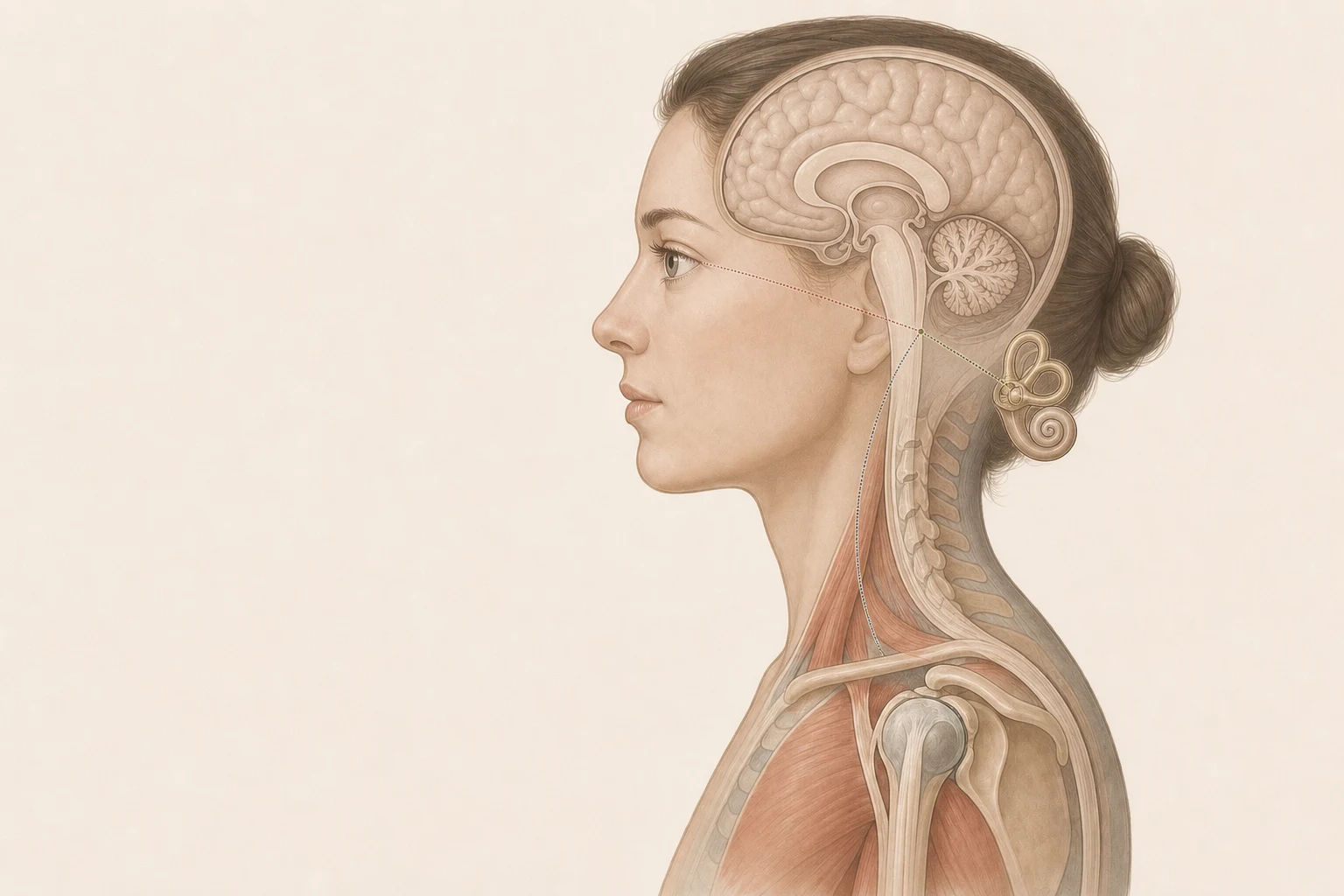
Balance is maintained not only by information from the ears but by processing visual, vestibular, and somatic sensory information together.
Photos show daily life scenes where symptoms appear, and explanatory diagrams simplify how reactions in the ears, balance, nerves, and the entire body are connected. They do not represent an individual's diagnostic or treatment results.If you have had these experiences
If your tests are normal, but you repeatedly experience brain fog and a slowing of speech and work
Some people are told their tests are normal, yet they find themselves re-reading text or unable to recall words during conversation, making it impossible to work at their previous speed. Instead of dismissing brain fog as just a mood, we translate it into actual functional terms.
Those who have noticed a significant decrease in the time their mind feels clear following sleep issues, infection, or overwork
When brain fog persists even after necessary blood, sleep, medication, and neurological evaluations
Those who have experienced an increase in work mistakes and speech blocks, but whose condition was not explained by test results alone
When recovery of concentration is slow following dizziness, migraines, or digestive discomfort
Those who experience brain fog on the same day as headaches, dizziness, pulsating sensations, or digestive discomfort
When there are clear fluctuations in sleep, body temperature,pulsatinglethargy, and the time the mind feels clear
This is how we approach the medical evaluation
Brain fog: The sequence of symptom onset and symptoms to check first
Brain fog is not a single diagnosis. While considering potential causes such as changes following sleep, medication, anemia, thyroid issues, or infection, as well as depression, anxiety, migraines, and dizziness, we specify exactly when concentration, word-finding, and processing speed break down.
Translating the term 'brain fog' into functional terms
Write down actual scenarios: whether you cannot recall words, cannot retain what you have read, or feel dizzy when looking at a screen.
Identifying the times of day when your mind feels clearest
We observe when symptoms are most severe, such as immediately after waking, after meals, in the afternoon, during menstruation, or following a headache, and how much recovery occurs.
Aligning the sequence of sleep and various symptoms
We use a timetable to organize whether insomnia comes first, or if brain fog follows dizziness, headaches, or pulsating sensations.
Reasons why it may not heal easily
Physical conditions that coincide with days when brain fog persists
Brain fog is not a single diagnosis. While maintaining an investigation into causes such as changes following sleep, medication, anemia, thyroid issues, or infections, as well as depression, anxiety, migraines, and dizziness, we specify exactly when concentration, word-finding, and processing speed break down.
Distinguishing the first symptom from the following symptoms
Pulsating sensations, dizziness, cold sweats, nausea,Tremor· Amidst the grogginess, record what occurred first and what followed a few minutes later.
Observe the timing relative to posture, meals, and sleep
Keep only the recurring connections, noting how many minutes or hours after standing up, showering, fasting, eating, or staying up all night the symptoms began.
Measure the recovery time after an episode ends
Observe how long it takes for energy, concentration, and walking to return to normal, even after heart rate or nausea have subsided.

Placing the test name, date of administration, first symptom, accompanying symptoms, and recovery time on the same timeline allows for a more continuous flow of questions during multiple medical evaluations.
Conceptual reference · NICE: Shared decision making · AHRQ: Questions Are the AnswerTest and lifestyle records
How to place test results and lifestyle records on a single timeline
Please tell us the times when your head feels clear and the specific work scenarios where you feel blocked.
First, we evaluate the cause and the influence of medications
We do not mask new symptoms under the general name of 'brain fog'.
Select the cognitive function that has become most uncomfortable
Determine the primary discomfort among word-finding, reading, screen use, or planning.
Adjustments based on clear-headed intervals and recovery
We compare the duration of sustained concentration with the level of exhaustion the following day.
Korean herbal medicine pattern identification for brain fog
If tests are normal but you repeatedly experience a foggy head and slowness in speech and work, Korean herbal medicine treatment categorizes this into four patterns
We observe whether brain fog worsens after lack of sleep or occurs alongside headaches, dizziness, digestive issues, or decreased energy. After the necessary causal evaluations, the actual coinciding physical states are reflected in the Korean herbal medicine prescription.
When the head feels empty and energy drops even with slight concentration
We check if word-finding and processing speed slow down in the afternoon or after overwork. We ask about paleness, dizziness, loss of appetite, and cold hands and feet. We supplement Qi, blood, and recovery power to reduce exhaustion after concentrating.
When the head feels heavy and vision on screens is blurry, like motion sickness
We check if brain fog is accompanied by floating dizziness or nausea. We verify bloating, edema, phlegm, and heaviness on rainy days. By reducing the burden of phlegm-fluid (dam-tak), we help restore visual tasks and mental clarity.
When light sleep and excessive worry make it hard to retain memories
We check if it is difficult to retain read content after waking up in the early morning. We ask about pulsating sensations, cold sweats, loss of appetite, and fatigue. We simultaneously supplement sleep, mental stability, and energy.
Changes to monitor during treatment
The aspects of daily life you wish to reclaim before resolving brain fog
By converting vague fogginess into specific functions of work, reading, and conversation, we increase the clear-headed hours and the range of sustained concentration.
Actual blocked scenarios among word-finding, reading, screen use, or work
In the first consultation, we use these criteria as the current starting point. We aim to transform vague brain fog into functional capacity for work, reading, and conversation, thereby increasing the duration of mental clarity and the range of sustained concentration.
The clearest and cloudiest times of the day, and sleep, diet, and menstruation
We adjust treatment priorities by comparing changes over several days rather than relying on a single good day. We aim to transform vague brain fog into functional capacity for work, reading, and conversation, thereby increasing the duration of mental clarity and the range of sustained concentration.
Current medications, test results, and recovery time after dizziness or headaches
The direction of subsequent visits is determined based on the lifestyle the patient wishes to return to. We aim to transform vague brain fog into functional capacity for work, reading, and conversation, thereby increasing the duration of mental clarity and the range of sustained concentration.
At the crossroads of test results and recovery speed
If test results are normal but you experience recurring brain fog and slowness in speech and work, Korean herbal medicine distinguishes between four categories
We examine whether brain fog worsens after lack of sleep, or if it occurs alongside headaches, dizziness, digestive issues, or decreased energy. After the necessary causal evaluation, the actual changes in physical condition are reflected in the Korean herbal medicine prescription.
Pattern identification is not about grouping various symptoms into a single autonomic nerve issue. While maintaining the causes to be verified in ear, balance, nerve, and heart evaluations, we identify the axis where dizziness, tinnitus, headache, facial movement, sleep, digestion, body heat, and heart rate actually change together to adjust the priority of the prescription.
When the mind goes blank and energy drops even with slight concentration
- Changes observed in the head, ears, and face
- We check if word-finding and processing speed slow down in the afternoon or after overworking.
- Changes observed throughout the body
- We ask about pallor, dizziness, loss of appetite, and cold hands and feet.
- Prescription Priority
- We reduce exhaustion after concentration by reinforcing Qi, blood, and recovery power.
When the head feels heavy and vision is blurry, as if experiencing motion sickness from a screen
- Changes observed in the head, ears, and face
- We check if brain fog is accompanied by a floating sensation of dizziness or nausea.
- Changes observed throughout the body
- We check for bloating, edema, phlegm, and a feeling of heaviness on rainy days.
- Prescription Priority
- We help recover visual task performance and mental clarity by reducing the burden of phlegm-fluid (dam-tak).
When sleep is shallow and anxiety is high, making it difficult to retain memories
- Changes observed in the head, ears, and face
- We check if it is difficult to retain read content after waking up in the early morning.
- Changes observed throughout the body
- We ask about palpitations, cold sweats, loss of appetite, and fatigue.
- Prescription Priority
- We simultaneously supplement sleep, mental and physical stability, and energy.
When the head feels hot, the body feels cold, and the mind is foggy
- Changes observed in the head, ears, and face
- We check if concentration drops sharply after facial heat or eye fatigue.
- Changes observed throughout the body
- We check for cold hands and feet, sweating, menstruation, digestion, and daily fluctuations.
- Prescription Priority
- We increase the periods of mental clarity by reducing significant fluctuations in body heat and autonomic responses.
Order of Prescription Adjustment
- We first verify the cause and the influence of medications.
We do not mask new symptoms under the general term 'brain fog'.
- We identify the single most bothersome cognitive function.
We determine the primary discomfort among word-finding, reading, screen use, or planning.
- We make adjustments based on the recovery and periods of mental clarity.
We compare the duration of concentration with the level of exhaustion the following day.
- Change one priority at a time and verify through daily functioning
Rather than simply asking if your head feels clear, we observe changes in the time spent reading documents, the frequency of missing details during conversations or meetings, and the recovery time after activities.
Why consider Korean herbal medicine treatment now?
- When brain fog persists even after necessary blood, sleep, medication, and neurological evaluations
- When recovery of concentration is delayed following dizziness, migraines, or digestive discomfort
- When there are distinct fluctuations in mental clarity alongside sleep, body heat, pulsating sensations, lethargy, or fatigue
What is verified in Korean herbal medicine treatment for this condition
- Actual instances of being stuck during word-finding, reading, screen use, or work
- The clearest and foggiest times of the day, as well as sleep, diet, and menstruation
- Current medications, test results, and recovery time after dizziness or headaches
We first rule out sudden confusion and sudden neurological symptoms
If the onset is sudden and accompanied by weakness on one side of the body, difficulty speaking, or changes in consciousness, we will connect you to immediate emergency help rather than a Korean herbal medicine consultation.
We specify changes in concentration, memory, and word-finding
By recording missed appointments, work errors, possible concentration time, and dates of changes in sleep, infections, or medications, we help distinguish the cause during standard medical evaluation.
We consult on recurring daily discomforts following diagnosis
Without arbitrarily changing existing treatments, we observe weekly changes in fatigue, sleep, and concentration to explain the scope and limits of integrating Korean herbal medicine treatment.
Things to prepare before the consultationPlease organize the date symptoms began, possible concentration time, actual work or appointment errors, sleep and recent infections, changes in medications, depression, anxiety, and physical examination results before your medical consultation.
If new paralysis, slurred speech, gait disturbance, sudden hearing loss, thunderclap headache, chest pain, dyspnea, or fainting occurs, a prompt medical evaluation is required even if previous tests were normal. After ruling out these exceptions, we focus on herbal medicine treatment for chronic, recurrent, and recovery-phase symptoms.
Consult about brain fogDizziness, Ear, Head, and Face Glossary
Additional information regarding brain fog
You can check simple definitions before proceeding to detailed explanations.Frequently Asked Questions
Frequently Asked Questions about Brain Fog
Is brain fog a medical diagnosis?
Rather than being a formal diagnosis, it is an expression used to group together difficulties with concentration, memory, word-finding, and processing speed. The cause is evaluated separately based on when it started and accompanying symptoms.
Can lack of sleep cause brain fog symptoms?
Sleep issues and severe fatigue can affect concentration and memory. Please record your sleep duration, daytime sleepiness, and recovery after rest; if these persist, seek medical evaluation.
Can a feeling of mental cloudiness persist after an infection?
Difficulties with thinking and concentration are reported in chronic symptoms following infection or in Long COVID. Since other causes are possible, please provide the start date, any fluctuations, and details regarding fatigue and sleep.
When should I go to the emergency room immediately?
If you experience sudden confusion, weakness on one side of the body, difficulty speaking or understanding, severe headache, or decreased consciousness, seek help from 119 or the emergency room immediately.
Can lack of sleep cause brain fog?
Since sleep issues are a possible cause of decreased memory and concentration, please record your sleep patterns and daytime sleepiness.
If I feel cloudy after taking a new medication, should I stop taking it?
Review the possibility of medication side effects with your prescriber, but do not discontinue prescribed medication arbitrarily.
If it starts after COVID, is it Long COVID?
It may be in the context of Long COVID, but we also evaluate fatigue, sleep, worsening after activity, and other correctable causes.
What should I record when visiting for brain fog treatment with Korean herbal medicine?
Please note the first day you felt mentally cloudy, the times when it worsens, changes in sleep, diet, or medications, and tasks that have become difficult, such as reading documents or having conversations. Please also prepare any blood or neurological test results you have received.
Does Korean herbal medicine treatment for brain fog replace existing tests or treatments?
Sudden paralysis, slurred speech, vision changes, or severe headaches that start like a thunderclap require a neurological evaluation before Korean herbal medicine treatment. Once acute causes are ruled out, we determine goals for concurrent treatment if pain, spasms, or fatigue remain.
If my brain fog test results were normal, do I still need to bring my records?
Please provide the name and date of the tests, as well as the sequence of remaining brain fog, lack of sleep, headache, or dizziness after the tests. If there is a sudden change in consciousness or speech, seek medical evaluation again regardless of previous normal results.
Evidence and Update Information
This content was compiled by Korean medicine doctor Choi Yeon-seung based on the official professional materials and disease-specific clinical data below, and was updated on 2026-08-26.
- American Heart Association: Arrhythmia symptoms and monitoringConnection between palpitations, dizziness, fainting and ECG/symptom records
- American Heart Association: Heart attack symptomsEmergency evaluation boundaries for chest pain, shortness of breath, cold sweats, and nausea
- MedlinePlus: Heart palpitationsCommon accompanying symptoms of palpitations and record items to prepare for consultation
- NHS: Feeling sick (nausea)Common situations for nausea and clinical guidance needed for dehydration or progressing symptoms
- NINDS: TremorMaterials explaining the area, situation, neurological evaluation, and treatment scope of tremors
- CDC: Stroke signs and symptomsEmergency criteria for sudden one-sided weakness or speech changes that must be distinguished from tremors or lethargy
- NICE: Transient loss of consciousnessClinical criteria for branching between fainting/near-fainting sensations and cardiac/neurological evaluations
- Johns Hopkins Medicine: POTSDescription of a patient group where heart rate, dizziness, brain fog, and lethargy are linked after postural changes