Understanding Terms
What the Term 'Autonomic Dysfunction' Explains and What It Doesn't
By distinguishing whether symptoms worsen when standing, occur as episodes even while still, or fluctuate according to meals and body temperature changes, the necessary tests and goals for Korean medicine treatment become much more specific.
When pulsating sensations, dizziness, cold sweats, nausea, and sleep issues all fluctuate at once, 'Autonomic nervesMany people search for the term 'dysautonomia.' While it serves as a starting point for connecting various symptoms, it is not a diagnosis that is resolved with a single test or prescription.
The autonomic nervous system regulates not only the heart but also digestion, sweating, and body temperature.
The autonomic nervous system adjusts functions that we do not consciously control, such as heart rate, blood pressure, sweating, intestinal movement, and body temperature, to fit the situation. Therefore, if this regulation is disrupted, pulsating it does not occur as a single issue, but may appear as a cluster of dizziness, coldness in the hands and feet, cold sweats, nausea, diarrhea or constipation, and sleep instability.
However, 'dysautonomia' is a widely used expression to understand this group of symptoms, not a diagnostic name that confirms a single cause. We must examine the overall regulatory patterns of the body while identifying causes that create similar appearances, such as anemia, thyroid issues, arrhythmia, medication effects, or vestibular diseases.
Severe symptoms when standing are viewed differently from episodes that occur even while remaining still.
If your heart races and your vision blurs after standing for a long time or taking a hot shower, and these improve upon sitting or lying down, we first consider orthostatic regulation issues. Postural Orthostatic Tachycardia Syndrome (POTS) is a specific diagnostic category that confirms whether the heart rate increases above a certain threshold within 10 minutes of standing up from a lying position, along with these symptoms. Not all heart racing or fatigue can be called POTS.
Conversely, if heart racing starts suddenly even while sitting and resting, or if the pulse is irregular, vertigoor if symptoms in one ear are prominent, a different evaluation is required. Simply distinguishing between scenarios where the body's regulatory burden increases, such as heat, standing, eating, or bowel movements, and episodes that occur without any trigger changes the starting point of the medical evaluation.
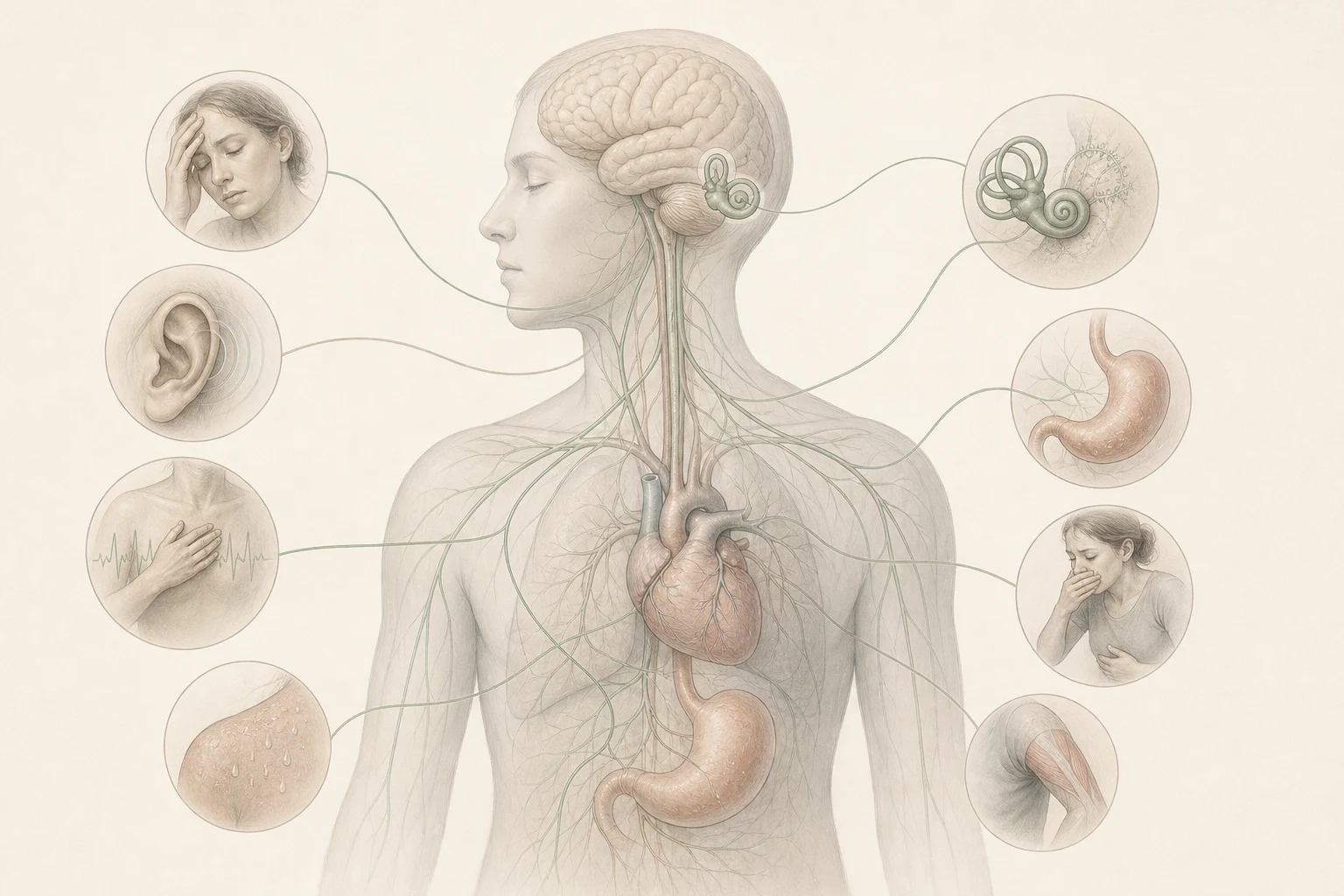
While the systemic response is real, the term 'autonomic nerve' alone does not replace a diagnosis of cardiac, neurological, or endocrine causes.
The statement that test results were normal is not the same as saying the symptoms are mild.
If an ECG, blood test, or brain imaging was normal, it serves as an important basis for lowering the possibility of the diseases being checked. At the same time, it does not mean that temporary rhythm changes during untested times, blood pressure or heart rate changes according to posture, or the increased symptom burden caused by the collapse of sleep and digestion have all been explained.
If we know the names and dates of tests already received and what new changes have occurred since then, we can determine the next question rather than repeating the same tests. If the pattern has changed, such as chest pain, fainting, or new one-sided paralysis, we do not categorize current symptoms based solely on previous normal results.
Korean medicine treatment begins by identifying which regulatory axis collapsed first.
Even for the same heart racing, the focus of treatment differs for a person who experiences cold sweats and dizziness as their energy drops, a person whose chest and solar plexus feel blocked and heat rises after stress, and a person whose nausea and brain fog worsen after meals. In Korean medicine, we distinguish the recovery power of Qi and Blood, moisture metabolism and digestive burden expressed as 'Dam-eum' (phlegm-fluid), and the imbalance of tension and heat according to the actual sequence of symptoms.
Herbal medicine treatment at Baekrokdam does not prescribe for the single word 'autonomic nervous system.' We define the functions the patient wishes to regain, such as the strength to endure after standing in the morning, recovery after meals, adaptation to body temperature changes, or the number of times they wake up after falling asleep, and adjust the prescription to match the cluster of symptoms hindering those functions.
Lifestyle management is not a homework assignment to test your body, but a way to reduce sudden fluctuations.
If orthostatic symptoms are prominent, it helps to divide the process of getting up from a lying position into stages, avoid hot environments and prolonged standing, and avoid consuming fluids and meals in excessive concentrated amounts. Methods that vary depending on the condition, such as salt intake or compression garments, should be decided with your attending medical staff considering your blood pressure, heart, and kidney status.
There is no need to record every symptom in detail every day. Before the medical evaluation, simply recalling the posture, meals, heat, pulse sensation, accompanying digestive/sweating/headache symptoms, and recovery time from the two or three most difficult episodes is sufficient to determine treatment priorities.
Recovery is not evaluated solely by the days when symptoms completely disappear.
Important signs of recovery also include changes such as needing less time to sit down after a shower, feeling less grogginess after meals, and a reduction in the exhaustion that used to last until the day after going out. Rather than focusing on the frequency of pulsating sensations alone, we look at whether the speed of returning to daily life and the range of activity improve together, even when symptoms occur.
When continuing Korean herbal medicine treatment, we analyze responses separately, for example, whether only sleep has improved while orthostatic dizziness remains, or whether digestion has become easier but heat sensations and sweating persist. This allows us to refine the treatment to address the most bothersome remaining symptoms, rather than vaguely maintaining a single prescription for a long time.
Autonomic dysfunction is the starting point for understanding the connection between various symptoms. We first identify which functions are unstable depending on posture, heat, meals, or sleep; then, after necessary examinations, we set the remaining recovery capacity and accompanying symptoms as specific goals for Korean herbal medicine treatment.
Evidence and Update Information
This content was organized by Korean medicine doctor Choi Yeon-seung based on the materials below and was updated on 2026-08-26.
- American Heart Association: Arrhythmia symptoms and monitoringConnection between palpitations, dizziness, fainting and ECG/symptom records
- American Heart Association: Heart attack symptomsEmergency evaluation boundaries for chest pain, shortness of breath, cold sweats, and nausea
- MedlinePlus: Heart palpitationsCommon accompanying symptoms of palpitations and record items to prepare for consultation
- NHS: Feeling sick (nausea)Common situations for nausea and clinical guidance needed for dehydration or progressing symptoms
- NINDS: TremorMaterials explaining the area, situation, neurological evaluation, and treatment scope of tremors
- CDC: Stroke signs and symptomsEmergency criteria for sudden one-sided weakness or speech changes that must be distinguished from tremors or lethargy
- NICE: Transient loss of consciousnessClinical criteria for branching between fainting/near-fainting sensations and cardiac/neurological evaluations
- Johns Hopkins Medicine: POTSDescription of a patient group where heart rate, dizziness, brain fog, and lethargy are linked after postural changes
- NIDCD: Balance DisordersSensations of dizziness and imbalance: Basic pathways for equilibrium system evaluation and rehabilitation
- Bárány Society: Classification of vestibular symptomsCriteria for verbally distinguishing between vertigo, non-rotational dizziness, and symptoms triggered by posture or vision