Visually Induced Dizziness
Why do I feel dizzy in supermarkets, looking at screens, or in vehicles? Differences between Visual Dependence, PPPD, and Vestibular Migraine
We distinguish between visual dependence remaining after acute dizziness, Persistent Postural-Perceptual Dizziness (PPPD) lasting more than 3 months, and vestibular migraines occurring in episodes; we then expand the capacity to tolerate complex environments through vestibular rehabilitation and Korean herbal medicine and acupuncture treatments.
If you feel unsteady when shelves pass by quickly, when scrolling through a screen, or when looking out a car window, it may be more than just eye fatigue. The balance system can become overloaded when the eyes, the vestibular organs of the ear, and the proprioception of the soles of the feet and joints signal different movements.
| Category | Prominent Symptoms | Duration/Pattern |
|---|---|---|
| Visual dependence · residual dizziness | Staggering while walking or looking at screens after BPPV or vestibular neuritis | Remains after movement and may gradually decrease during recovery |
| PPPD | Accumulates while standing, walking, in supermarkets, in crowds, or while scrolling | Persists for more than 3 months on most days |
| Vestibular migraine | Sensitivity to light, sound, visual movement, nausea, and headaches | Recurrent episodes lasting from 5 minutes to 72 hours |
| Motion sickness | Nausea and cold sweats in cars, boats, or during virtual movement | Starts during travel and subsides after stopping |
Balance is created not only by the ears but also by the eyes and body sensations together
Humans sense head movement through the vestibular system in the inner ear, see which direction the surroundings are flowing with their eyes, and confirm where the body is standing through the soles of the feet and joints. When these three pieces of information align, the surroundings appear stable even when walking between shelves or turning the head.
If vestibular function on one side is weakened or if the body relies too heavily on visual information, complex patterns and moving screens can actually disrupt balance. Because it feels better when closing the eyes, it is easy to mistake this for only an ophthalmological issue, or to leave the dizziness as an unexplained symptom simply because ear tests were normal.
Even after acute dizziness ends, a habit of relying on vision to maintain balance may remain.
Canalith repositioning procedure The spinning sensation may have stopped, but you may still feel floaty when walking, or feel as if the screen is shaking when turning your head after vestibular neuritis. To avoid falling, the body tries to gaze more intensely at the surroundings and stiffens the neck and torso, but this compensation easily becomes overloaded in environments with significant visual movement, such as supermarkets, intersections, or while scrolling.
At this stage, balance does not return simply by closing your eyes and avoiding all stimuli. While continuing to reuse the remaining vestibular function and walking Vestibular Rehabilitationyou must also treat the areas where recovery after practice is excessively slow due to nausea, neck tension, and fatigue.
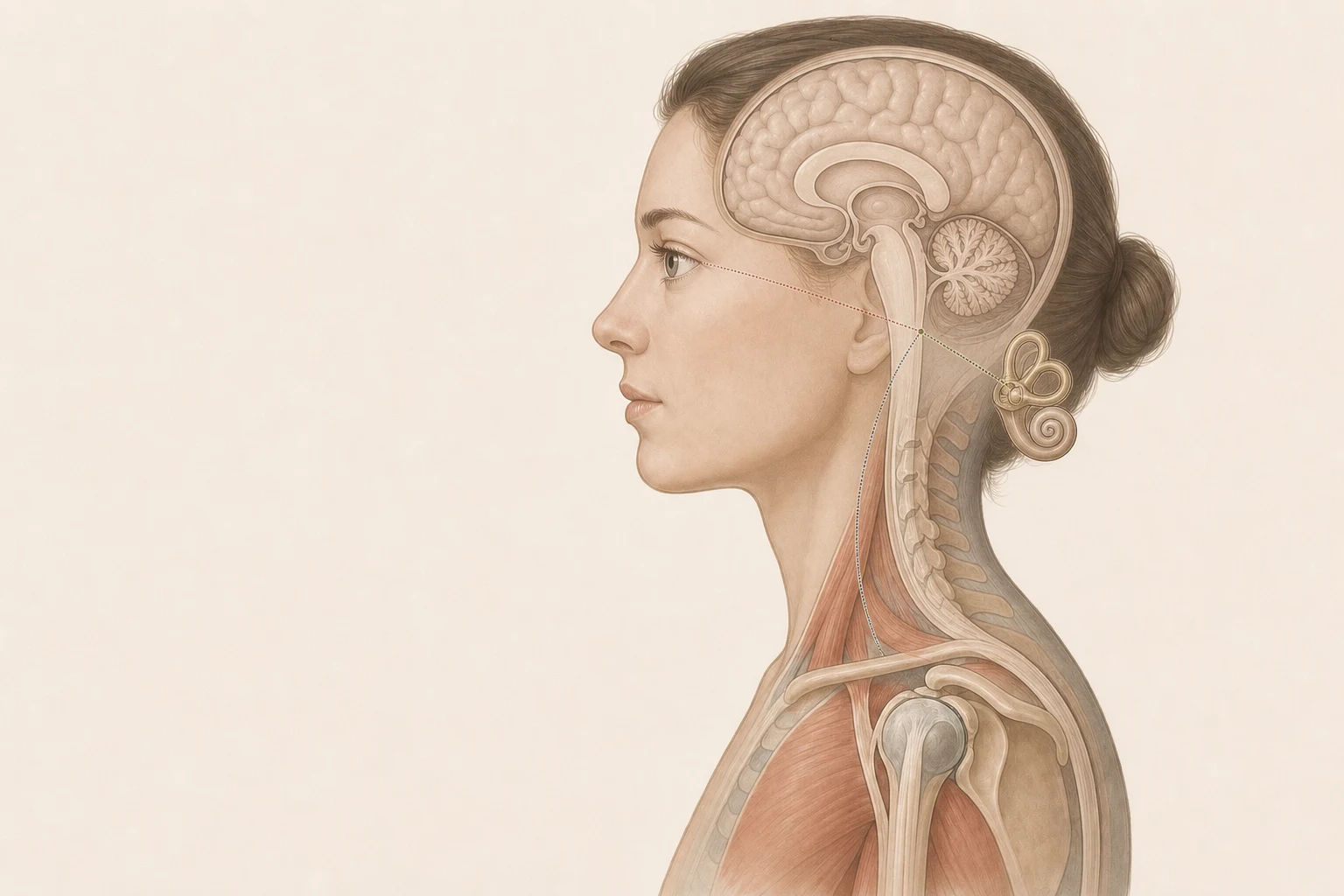
Balance is maintained not only by information from the ears but by processing visual, vestibular, and somatic sensory information together.
PPPD persists most days and accumulates from posture and visual stimuli
Persistent Postural-Perceptual Dizziness (PPPD) is characterized by swaying, floatiness, or instability that lasts for most days over a period of 3 months or more, rather than spinning attacks. It accumulates more when standing or walking than when lying still, when the body or surroundings move, or in places with complex visual information such as supermarket aisles, crowds, or fast-moving screens.
Initially, BPPVevents such as vestibular neuritis, migraines, or panic attacks trigger the dizziness; even after the acute problem subsides, the balance system may remain in a state of high alert. PPPD does not mean the symptoms are fabricated, but is a functional vestibular disorder where the brain's way of processing posture and movement has become hypersensitive.
Vestibular migraine is characterized more by attacks and migraine features than by a persistent state
Vestibular MigraineDizziness can be triggered by visual movement and head movement, accompanied by sensitivity to light and sound, nausea, and visual auras. A headache does not have to occur every time, but we look at the temporal structure of recurrent attacks lasting from 5 minutes to 72 hours, similar to past migraines.
PPPD and vestibular migraine can occur together. If you constantly feel swaying in supermarkets and in front of screens, but experience separate strong attacks after lack of sleep, menstruation, or overwork, both the persistent and attack-type forms must be treated. Motion sickness is a different category in that it relatively subsides after movement stops.

Rather than the intensity of the fuzziness, record how long you can sustain reading, screen use, conversation, or work.
Herbal medicine and acupuncture treatment address the body's collapse following visual stimuli
For those who feel head heaviness, nausea, and a blocked sensation in the stomach in supermarkets or vehicles, the proportion of Dam-eum (phlegm-fluid retention) is high. If facial heat, headache, glare, and insomnia surge after screen use, we address both upper-body heat and migraine sensitivity. For those who lose energy easily even after walking a short distance and experience prolonged swaying, the recovery of Qi and Blood must be reinforced.
Herbal medicine treatment is not a prescription that simply suppresses dizziness, but adjusts the axis that holds the recovery of balance among digestion, sleep, body heat, and energy. Acupuncture treatment helps the head and gaze move naturally again by reducing tension in the neck, jaw, occipital region, and chest, and is performed in parallel with necessary vestibular rehabilitation.
The goal of treatment is to reduce recovery time without avoiding complex spaces
Initially, it helps to look at stable points such as the end of a display shelf, reduce the time spent on fast scrolling or viewing multiple screens simultaneously, and take short breaks before symptoms explode. However, if you completely avoid supermarkets, vehicles, or screens, it is difficult for the balance system to relearn movement, so stimuli should be gradually expanded within a tolerable range.
Improving does not mean staying home until dizziness becomes 0. It means being able to finish necessary grocery shopping, regaining balance within a short time after getting out of a vehicle, and expanding the capacity to continue the next schedule after screen-based work. Baekrokdam adjusts the weight of herbal medicine and acupuncture treatment according to this speed of returning to daily life.
Dizziness that worsens in supermarkets, in front of screens, or in vehicles must be categorized into visual dependence, PPPD, vestibular migraine, and motion sickness based on timing and accompanying symptoms. While continuing vestibular rehabilitation, we address Dam-eum, upper-body heat, Qi and Blood deficiency, and neck tension with herbal medicine and acupuncture to accelerate recovery after complex environments.
Evidence and Update Information
This content was organized by Korean medicine doctor Choi Yeon-seung based on the materials below and was updated on 2026-08-31.
- NIDCD: Balance DisordersSensations of dizziness and imbalance: Basic pathways for equilibrium system evaluation and rehabilitation
- Bárány Society: Classification of vestibular symptomsCriteria for verbally distinguishing between vertigo, non-rotational dizziness, and symptoms triggered by posture or vision
- Bárány Society: PPPD diagnostic criteriaConsensus criteria for PPPD: persisting for 3 months or more and worsening with posture, movement, and visual stimuli
- NICE: Suspected neurological conditionsCriteria for prioritizing neurological evaluation in cases of dizziness accompanied by new gait disturbances, speech difficulties, or one-sided weakness.
- AAFP: Dizziness: Evaluation and ManagementA primary care approach to categorizing dizziness by onset timing, duration, and clinical findings.
- ICHD-3: Vestibular migraineCriteria for when dizziness, nausea, and visual sensitivity can appear without a headache