Headaches: Read in the order of your curiosity
Before grouping symptoms under a single name
Headaches are evaluated by onset speed, location, sensitivity to light and sound, and nausea
Headaches can appear as pressure or throbbing pain on one or both sides of the head, or in the front, side, or back, and may be accompanied by nausea, vomiting, and sensitivity to light, sound, or smell. Migraines often present as throbbing pain that gradually worsens on one side, along with nausea and sensory hypersensitivity; some experience auras before the pain, such as flashing lights in the vision, difficulty speaking, or numbness in the hands and face. However, if you experience new-onset paralysis, sensory loss, or speech impairment, Migraine aurashould not be the sole conclusion. Immediate emergency evaluation is required for a sudden onset of the worst headache of your life, seizures, decreased consciousness, one-sided paralysis, difficulty speaking or walking, loss of vision, high fever, neck stiffness, non-blanching rash, or a headache following head trauma.
Next steps by symptom
Prioritize based on onset speed and accompanying symptoms
Rather than looking only at pain intensity, first determine if the pattern differs from your usual experience or if there are neurological, infectious, or traumatic symptoms.
| Current Symptom | Possible Pattern | Next action |
|---|---|---|
| One-sided pulsating pain with nausea and sensitivity to light/sound | Common pattern in migraines | Confirm type through a headache diary and medical evaluation |
| Gradual headache following flashing vision or numbness | Possible migraine aura in some cases | Seek prompt medical evaluation if this is the first occurrence or if the pattern is different |
| Recurring tightening pressure | Possible other primary headache patterns | Record frequency, triggers, and medication use |
| Sudden onset of the worst headache of your life | Possible secondary headache emergency | Immediate emergency evaluation |
| Paralysis, speech/gait disturbance, decreased consciousness, seizures | Possible neurological emergency | Immediate emergency assistance |
| High fever, neck stiffness, non-blanching rash | Possible severe infection | Immediate emergency evaluation |
When to seek medical attention first
Headache Symptoms Requiring Immediate Emergency Evaluation
Do not wait for a response to painkillers or herbal medicine for the following symptoms:
- A first-time or worst-ever headache that starts suddenly and becomes extreme in an instant
- Seizures, decreased consciousness, one-sided paralysis, sensory loss, speech/gait/memory impairment
- Loss of vision, severe double vision, or new-onset confusion or drowsiness
- High fever, neck stiffness, photosensitivity, and a rash that does not disappear when pressed
- Severe headache that develops or worsens after head trauma
Focus on the time lost to the headache rather than the frequency of painkiller use
Distinguishing the location of the headache and accompanying light sensitivity, nausea, and neck tension
Headache evaluation first screens for risks such as new neurological symptoms, thunderclap pain, fever, and changes in consciousness. For recurrent headaches, the duration, sensitivity to light and sound, neck movement, menstruation, sleep, and days of painkiller use are checked along with the location of the pain.
Categorizing the different types of headaches
Record whether the pain is throbbing, pressing, or stabbing, whether it is one-sided or bilateral, and if it worsens with movement to distinguish the characteristics of migraine, tension-type, and secondary headaches.
Track both the days medication was taken and the days headaches occurred
Check a monthly calendar to see if painkillers provide only temporary relief or if the number of headache-free days has decreased as the days of medication use increase.
Focus on recovery function until the end, rather than just the pain
Track how much time is spent avoiding light, occurrences of vomiting, interruptions to screen time or work, and how long the next-day brain fog lasts.
Treatment GoalIncrease not only the intensity of headache relief but also the number of headache-free days, days lived without painkillers, and the amount of time spent continuing screen work.
Consult using headache records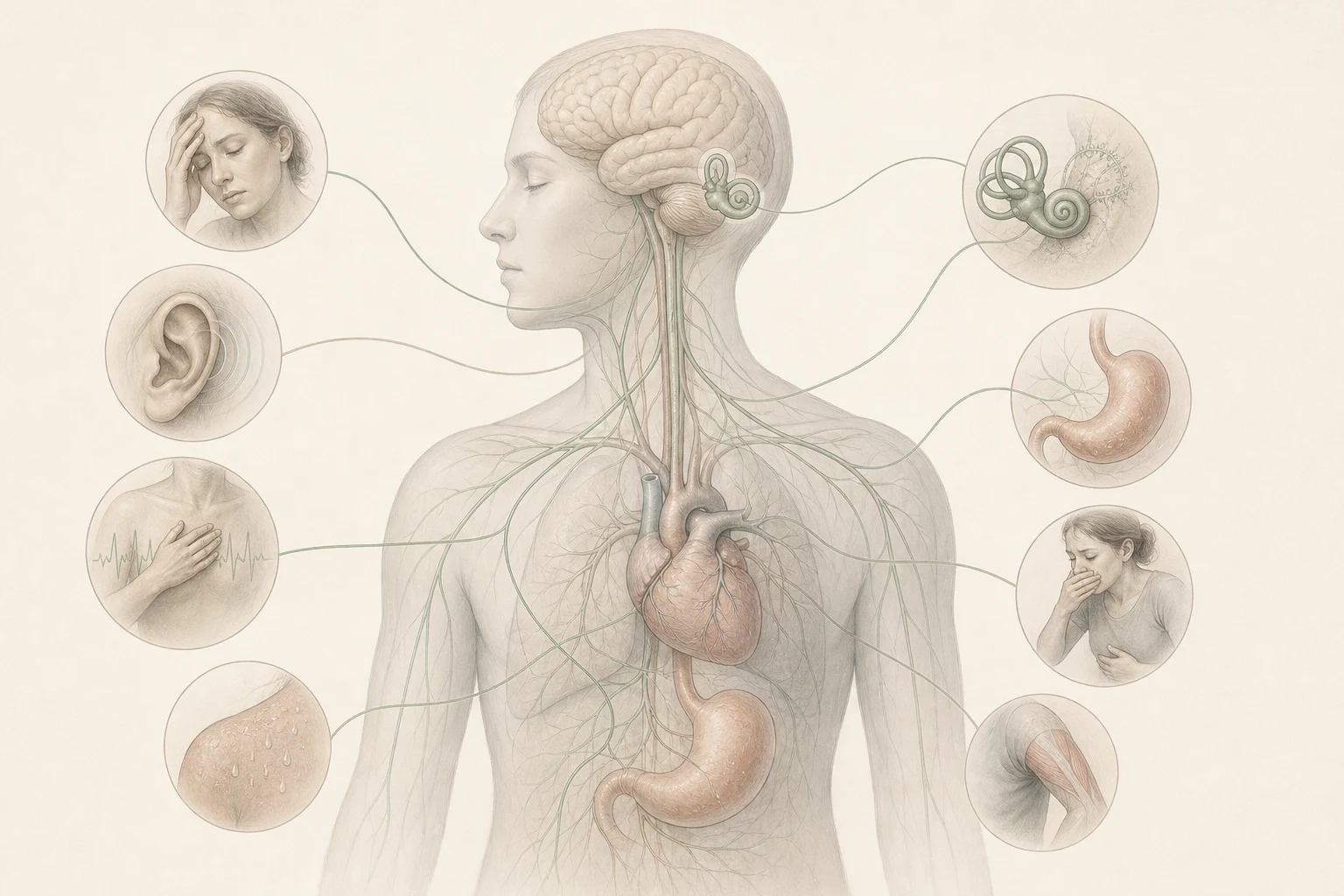
While the systemic response is real, the term 'autonomic nerve' alone does not replace a diagnosis of cardiac, neurological, or endocrine causes.
Photos show daily life scenes where symptoms appear, and explanatory diagrams simplify how reactions in the ears, balance, nerves, and the entire body are connected. They do not represent an individual's diagnostic or treatment results.If you have had these experiences
If you distinguish the location of the headache from the accompanying light sensitivity, nausea, and neck tension
Some people have no major abnormalities in tests but seek painkillers every time a headache occurs and adjust their schedules worrying that the medication may not work. We check the headache days, medication use days, and the recovery process together, rather than just the name of the pain.
For those who find it difficult to explain the type of headache because the location and pattern change every time
When headache days increase and dependence on painkillers grows even after necessary headache evaluations
For those who experience lingering light sensitivity, nausea, neck tension, and brain fog even after taking painkillers
When headache recurrence repeatedly coincides with sleep, menstruation, digestion, and neck tension
For those whose headaches recur after lack of sleep, menstruation, meals, or tension
When pain decreases but light sensitivity, nausea, andbrain fogpersist for a long time
This is how we approach the medical evaluation
Headaches: The sequence of symptom onset and symptoms to check first
For headaches, we first screen for risks such as new neurological symptoms, thunderclap-onset pain, fever, and changes in consciousness. For recurring headaches, we check the duration, sensitivity to light and sound, neck movement, menstruation, sleep, and days of pain reliever use, as well as the location of the pain.
Categorizing the different types of headaches
By recording whether the pain is throbbing, pressing, or stabbing, whether it is unilateral or bilateral, and if it worsens with movement, Migrainewe distinguish the characteristics of tension-type and secondary headaches.
Tracking days of medication use alongside headache days
We use a monthly calendar to see if pain relievers provide only temporary relief and if the number of headache-free days has decreased as the frequency of medication use increases.
Focusing on recovery function beyond the pain
We track the amount of time spent avoiding light, occurrences of vomiting, interruptions in screen use or work, and how much brain fog remains the following day.
Reasons why it may not heal easily
Body conditions associated with days when headaches persist
For headaches, we first screen for risks such as new neurological symptoms, thunderclap-onset pain, fever, and changes in consciousness. For recurring headaches, we check the duration, sensitivity to light and sound, neck movement, menstruation, sleep, and days of pain reliever use, as well as the location of the pain.
Note the symptoms that occur before the pain begins
Please record the start time and whether neck tension, yawning, light sensitivity, vision changes, or nausea began suddenly or gradually.
Track activities you were unable to perform while in pain
Record the duration of interrupted activities, such as meetings, driving, eating, childcare, or screen work, and the time you were required to lie down.
Post-pain grogginess is also considered part of the attack
Even after the pain subsides, separately track how long it takes for concentration, speech, energy levels, and digestion to return to normal.

Placing the test name, date of administration, first symptom, accompanying symptoms, and recovery time on the same timeline allows for a more continuous flow of questions during multiple medical evaluations.
Conceptual reference · NICE: Shared decision making · AHRQ: Questions Are the AnswerTest and lifestyle records
How to place test results and lifestyle records on a single timeline
Please let us know the days you had headaches, the days you used medication, and any discomfort that persisted into the next day.
Categorizing headache types and symptoms to check first
Sudden changes and neurological symptoms are prioritized for evaluation.
Aligning headache days, medication use, and accompanying symptoms
We identify the patterns of recurrence on a calendar to determine the priority of the prescription.
Adjusting treatment based on functional time without headaches
We compare screen use, work, and sleep with the recovery status the following day.
Korean herbal medicine pattern identification for headaches
While headaches can be categorized by location and accompanying symptoms like light sensitivity, nausea, and neck tension, Korean herbal medicine treatment distinguishes between four main patterns.
Rather than just the location of the headache, we check the onset speed, duration, and reactions to light, sound, and neck/shoulder tension. After the necessary causal evaluation, changes in sleep, digestion, and body heat are reflected in the Korean herbal medicine prescription.
When there is throbbing pain, sensitivity to light and sound, and rising heat
We check if the primary symptoms are pulsating pain in one temple, worsening with movement, and glare. We ask about lack of sleep, anger, neck/shoulder tension, and facial heat. We regulate pulsating pain and sensory hypersensitivity by lowering heat and tension in the upper body.
When the head feels heavy, nauseous, and foggy
We check if heaviness, dizziness, nausea, and discomfort with screens are more prominent than the pain. We check for bloating, phlegm, edema, and worsening on rainy days. We help recover from the brain fog and nausea following a headache by reducing phlegm-fluid (Dameum) and gastrointestinal burden.
When dull pain and fatigue persist after overworking
We check if you feel lightheaded and dizzy in the afternoon and if resting helps. We ask about paleness, loss of appetite, shallow sleep, and coldness in the hands and feet. By reinforcing Qi and blood, we raise the headache threshold and recovery capacity after overworking.
Changes to monitor during treatment
The quality of life you wish to reclaim beyond just treating the headache
We aim to increase not only the reduction in headache intensity but also the number of headache-free days, days lived without painkillers, and the amount of time you can spend on screens or work.
Monthly headache days, days of painkiller use, and the duration of a single episode
In the first consultation, these criteria serve as the current starting point. We aim to increase not only the reduction in headache intensity but also the number of headache-free days, days lived without painkillers, and the amount of time you can spend on screens or work.
Throbbing, pressure, location, and sensitivity to light, sound, or nausea
We adjust treatment priorities by comparing changes over several days rather than focusing on a single good day. We aim to increase not only the reduction in headache intensity but also the number of headache-free days, days lived without painkillers, and the amount of time you can spend on screens or work.
Sleep, menstruation, diet, neck and shoulder tension, and work interruption time
The direction of subsequent visits is determined based on the lifestyle the patient wishes to return to. We aim to increase not only the reduction in headache intensity but also the number of headache-free days, days lived without painkillers, and the amount of time you can spend on screens or work.
At the crossroads of test results and recovery speed
When dividing headaches by location and accompanying symptoms like light sensitivity, nausea, and neck tension, Korean herbal medicine distinguishes four categories
Rather than just the location of the headache, we check the onset speed, duration, and reactions to light, sound, and neck/shoulder tension. After a necessary cause evaluation, changes in sleep, digestion, and body heat are reflected in the herbal medicine prescription.
Pattern identification is not about grouping various symptoms into a single autonomic nerve issue. While maintaining the causes to be verified in ear, balance, nerve, and heart evaluations, we identify the axis where dizziness, tinnitus, headache, facial movement, sleep, digestion, body heat, and heart rate actually change together to adjust the priority of the prescription.
When there is throbbing pain, sensitivity to light and sound, and rising heat
- Changes observed in the head, ears, and face
- We check for throbbing in one temple, worsening with movement, and whether glare is the primary symptom.
- Changes observed throughout the body
- We ask about lack of sleep, anger, neck and shoulder tension, and facial heat.
- Prescription Priority
- By lowering heat and tension in the upper body, we manage throbbing pain and sensory hypersensitivity.
When the head feels heavy, nauseous, and foggy
- Changes observed in the head, ears, and face
- We check if heaviness, dizziness, nausea, and screen discomfort are more prominent than the pain itself.
- Changes observed throughout the body
- We check for bloating, phlegm, edema, and worsening on rainy days.
- Prescription Priority
- By reducing phlegm-fluid and gastric burden, we help recover from the fogginess and nausea following a headache.
When dull pain and a sense of exhaustion persist after overwork
- Changes observed in the head, ears, and face
- We check if you feel lightheaded or dizzy in the afternoon and if symptoms improve with rest.
- Changes observed throughout the body
- We ask about paleness, loss of appetite, shallow sleep, and coldness in the hands and feet.
- Prescription Priority
- By supplementing Qi and Blood, we increase the headache threshold and recovery capacity after overwork.
When pain is fixed in one spot and the neck feels stiff
- Changes observed in the head, ears, and face
- We check if stabbing or tightening pain is localized in the same area or linked to neck movement.
- Changes observed throughout the body
- We check for shoulder pain after sitting for long periods, clenching teeth, or experiencing tension.
- Prescription Priority
- By releasing stiff tendons and resolving blood stasis, we reduce the cycle of recurring pain.
Order of Prescription Adjustment
- Categorizing headache types and symptoms to be checked first
Sudden changes and neurological symptoms are prioritized for evaluation.
- Aligning headache days, medication use days, and accompanying symptoms
We identify the center of recurrence on the calendar to determine prescription priorities.
- Adjusting based on functional time without headaches
We compare screen time, work, and sleep with the recovery level the following day.
- Change one priority at a time and verify through daily functioning
We compare not only the intensity of pain but also activities stopped due to headaches, days painkillers were used, and whether fatigue lasting until the next day has decreased.
Why consider Korean herbal medicine treatment now?
- When headache days increase and dependence on painkillers grows even after necessary headache evaluations
- When headache recurrence repeatedly coincides with sleep, menstruation, digestion, or neck tension
- When light sensitivity, nausea, or brain fog persist long after the pain has decreased
What is verified in Korean herbal medicine treatment for this condition
- Number of headache days per month, days of painkiller use, and the duration of a single episode
- Throbbing, pressure, location, and sensitivity to light, sound, or nausea
- Sleep, menstruation, meals, neck and shoulder tension, and amount of work interruption time
Evaluating the speed of onset, sudden neurological symptoms, and signs of infection
Determine whether immediate medical evaluation is necessary by checking for the worst headache of your life, paralysis, speech or consciousness changes, vision changes, high fever, or neck stiffness.
Record the location, sensation, and accompanying symptoms
Organize throbbing or pressure, nausea, sensitivity to light/sound, and changes in vision or sensation in a headache diary.
Focus only on recurrent headaches after a neurology evaluation
Korean herbal medicine consultations are for chronic or recurrent pain and disruptions to sleep or work, and do not replace necessary tests or pharmacological treatments.
Things to prepare before the consultationPlease prepare information on the onset speed, location, sensation, and duration of the headache, as well as changes in vision, sensation, or speech, fever, trauma, use of painkillers, and previous test results.
If new paralysis, slurred speech, gait disturbance, sudden hearing loss, thunderclap headache, chest pain, dyspnea, or fainting occurs, a prompt medical evaluation is required even if previous tests were normal. After ruling out these exceptions, we focus on herbal medicine treatment for chronic, recurrent, and recovery-phase symptoms.
Consult using headache recordsDizziness, Ear, Head, and Face Glossary
Additional information regarding headaches
You can check simple definitions before proceeding to detailed explanations.Frequently Asked Questions
Frequently asked questions about headaches
What are the symptoms of a migraine?
Commonly, it involves pulsating pain that gradually worsens on one side, accompanied by nausea, vomiting, and sensitivity to light, sound, or smell. Some experience auras affecting vision, sensation, or speech.
Which types of headaches are emergencies?
Immediate evaluation is required for a sudden 'worst-ever' headache, paralysis, speech impairment, seizures, decreased consciousness, loss of vision, high fever, neck stiffness, non-blanching rashes, or headaches following trauma.
What should I record in a headache diary?
Please record the start time and speed of onset, location, sensation, duration, nausea, sensitivity to light/sound, changes in vision or sensation, medications taken, and the impact on your daily life.
Which test is used for headaches, CT or MRI?
One is not always better than the other. Medical staff choose based on the situation: a CT may be used when prompt confirmation is needed, such as for a sudden severe headache, while an MRI may be used for detailed structural evaluation, such as for progressive atypical headaches or neurological abnormalities.
If headaches recur, do I need imaging tests every time?
Imaging is not performed every time if it is a typical primary headache, the physical examination is normal, and the pattern has not changed. It will be re-evaluated if there are sudden changes or new neurological symptoms.
How detailed should the headache diary be?
Recording the start time, duration, intensity, location, accompanying symptoms, sleep, diet, activity, menstruation, medications taken, and their effects helps in determining the type of headache and whether medication overuse is occurring.
If test results are normal, is it okay to treat with only herbal medicine?
Treatment does not end simply because imaging is normal. For clinical diagnoses such as migraines,Tension-type headache treatment for the confirmed cause should be maintained, while Korean herbal medicine and acupuncture are consulted as supportive treatments for remaining chronic headaches and daily discomfort.
What information should I bring for Korean herbal medicine treatment for headaches?
Please record the date the headache started, the affected area, whether it started suddenly or gradually, and how long each episode lasts. Also, prepare the names of painkillers used, the frequency of use, and any accompanying symptoms.
Does Korean herbal medicine treatment for headaches replace existing tests or treatments?
Sudden paralysis, slurred speech, vision changes, or severe headaches that start like a thunderclap require a neurological evaluation before Korean herbal medicine treatment. Once acute causes are ruled out, we determine goals for concurrent treatment if pain, spasms, or fatigue remain.
Do I need to bring my records again even if the headache test results were normal?
Even if previous tests were normal, pain that starts like a thunderclap, neurological symptoms, or headaches that differ from before must be re-evaluated. Please provide the date of the test and any changes that occurred afterward.
Evidence and Update Information
This content was compiled by Korean medicine doctor Choi Yeon-seung based on the official professional materials and disease-specific clinical data below, and was updated on 2026-08-26.
- International Headache Society: ICHD-3International classification distinguishing migraines, tension-type headaches, chronic headaches, and secondary headaches
- ICHD-3: Vestibular migraineCriteria for when dizziness, nausea, and visual sensitivity can appear without a headache
- NICE: Headaches in over 12sEvaluation and tracking criteria for migraines, tension-type headaches, and medication-overuse headaches
- WHO: Migraine and other headache disordersOverview of the recurrence of headache disorders, functional loss, and appropriate medical approaches
- American Migraine Foundation: Headache diaryHeadache recording methods that include attack dates, trigger situations, medications taken, and lifestyle impairment
- CDC: Signs and Symptoms of StrokeEmergency pathways when accompanied by sudden weakness in the face or arms and changes in speech or gait
- NINDS: HeadachePrimary and secondary headaches: Patient guide on symptoms that should not be ignored and the diagnostic process