Meniere's disease: Read in order of your curiosity
Before grouping symptoms under a single name
In Meniere's disease, dizzy attacks occur alongside changes in hearing, tinnitus, and fullness
Meniere's diseaseIt is characterized by recurring rotational vertigo, where you or your surroundings feel like they are spinning, and loss of balance, coinciding with fluctuating hearing, tinnitus, or a deep feeling of pressure in the ear. Nausea and vomiting may accompany this, and symptoms may decrease between attacks. Over time, hearing loss or tinnitus may persist. If facial drooping, arm weakness, slurred speech, or vision changes occur suddenly, do not wait for a Meniere's disease diagnosis and seek emergency evaluation immediately.
Distinguishing symptom patterns
Distinguishing between attacks accompanied by ear symptoms and symptoms requiring prompt medical evaluation
Check if changes in rotation, balance, and hearing occur on the same timeline.
| Daily Life Scenario | Symptom Interpretation | Next action |
|---|---|---|
| Rotation following ear fullness or tinnitus | Possibility of Meniere's attack | Record attack timeline |
| Nausea or vomiting accompanying rotation | Accompanied by vestibular symptoms | Ensure safety and seek medical evaluation |
| Hearing loss between attacks | Possibility of hearing change | Consultation for hearing test |
| Changes in face, arms, speech, or vision | Possibility of stroke | Immediate emergency evaluation |
When to seek medical attention first
Symptoms that require prompt medical evaluation over Meniere's disease symptom consultation
The following are used to first check for brain or acute hearing issues.
- Sudden facial drooping, arm weakness, or changes in sensation
- Slurred speech or sudden blurring of vision in one eye
- Sudden hearing loss or rapid deterioration of hearing
- Persistent dizziness accompanied by inability to walk or changes in consciousness
When your ears and daily life remain unstable even between attacks
If dizziness, tinnitus, and ear fullness recur as a cluster and recovery is slow
Meniere's disease requires tracking of paroxysmal dizziness and fluctuating hearing symptoms at an otolaryngology clinic. Korean herbal medicine treatment does not replace that diagnosis, but rather addresses the remaining fullnesstinnitusimbalance, and the recurrence conditions of sleep, digestion, and body heat in chronological order.
Aligning the timeline of ear symptoms and dizziness
We track by date whether fullness, tinnitus, and hearing changes are precursors to an attack, occur simultaneously, or persist after recovery.
Addressing avoidance caused by unpredictable attacks
During treatment, we monitor whether you can resume driving, meetings, childcare, and outings, and how long the fatigue lasts after an attack.
Monitoring if sleep, salt intake, and overwork fluctuate alongside attacks
Rather than applying a uniform ban on lifestyle factors, we record only the specific items that consistently correlate with actual attacks.
Treatment GoalWhile maintaining hearing tracking and causal treatment, we aim to reduce recovery time between attacks and restore outings and work to the fullest possible extent.
Consult about Meniere's progress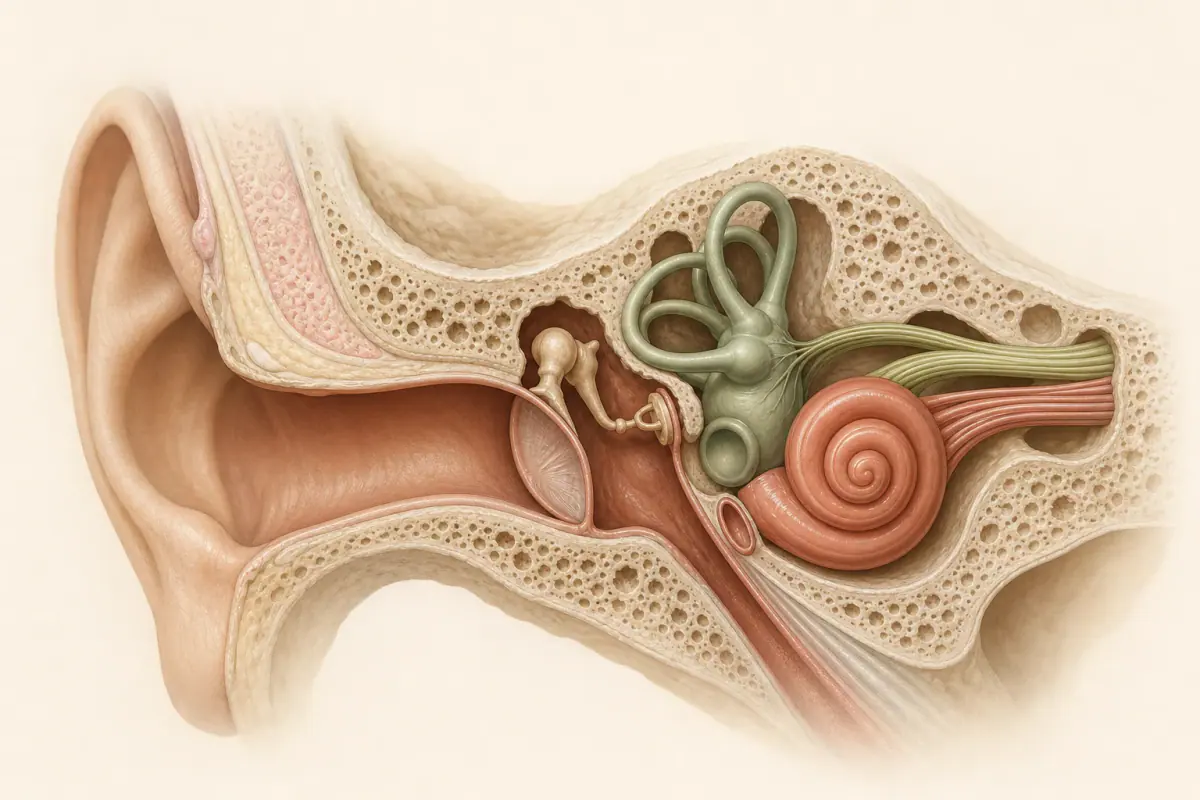
Although the auditory and balance organs are located close to each other, tinnitus, muffled ears, and dizziness must be evaluated through a combination of ear examinations and hearing and balance assessments.
Photos show daily life scenes where symptoms appear, and explanatory diagrams simplify how reactions in the ears, balance, nerves, and the entire body are connected. They do not represent an individual's diagnostic or treatment results.If you have had these experiences
If dizziness, tinnitus, and ear fullness recur as a cluster and recovery is slow
Dizziness and tinnitus, Ear Fullnesssome people postpone important appointments and travel because they do not know when these will return. While adhering to hearing tracking, we also verify how much the body recovers between attacks.
For those who find it difficult to go out alone due to fear of the next attack, despite receiving emergency care during each episode
When imbalance or tinnitus persists between attacks, even while continuing hearing tests and otolaryngology (ENT) care
For those confused because it varies each time whether ear fullness or tinnitus comes first, or if dizziness comes first
When recurrence of dizziness and ear fullness repeatedly overlaps with lack of sleep, overwork, or changes in body heat
For those who experience lingering brain fog, nausea, or lethargy for several days even after an attack ends
When returning to daily life is delayed due to nausea and lethargy following an attack
This is how we approach the medical evaluation
Meniere's disease: the sequence of symptom onset and symptoms to check first
Paroxysmal dizziness and fluctuating hearing symptoms of Meniere's disease must be tracked by an otolaryngology (ENT) clinic. Korean herbal medicine treatment does not replace that diagnosis; instead, it examines the chronological recurrence conditions of sleep, digestion, and body heat, as well as the fullness, tinnitus, and imbalance that remain between attacks.
Aligning the timeline of ear symptoms and dizziness
We align by date whether fullness, tinnitus, or hearing changes are precursors to an attack, occur simultaneously, or remain after recovery.
Examining avoidance behaviors caused by unpredictable attacks
During treatment, we observe whether you can resume driving, meetings, childcare, and outings, and how long the fatigue lasts after an attack.
Observing if sleep, salt intake, and overwork fluctuate alongside attacks
Rather than uniformly prohibiting lifestyle factors, we record only the items that are actually and repeatedly linked to attacks.
Reasons why it may not heal easily
Body conditions that fluctuate together on days when Meniere's disease symptoms persist
Paroxysmal dizziness and fluctuating hearing symptoms of Meniere's disease must be tracked by an otolaryngology (ENT) clinic. Korean herbal medicine treatment does not replace that diagnosis; instead, it examines the chronological recurrence conditions of sleep, digestion, and body heat, as well as the fullness, tinnitus, and imbalance that remain between attacks.
Observing the sequence of tinnitus, fullness, and hearing changes
Write in a single line whether they are precursors to dizziness, start simultaneously, or which specific symptoms remain after the attack ends.
Always indicate whether symptoms are unilateral or bilateral
Days when the direction of ear symptoms changes or hearing suddenly alters are evaluated separately from previous chronic symptoms.
Observing the extent of daily life recovery between attacks
Record the actual reduced range of activities, such as phone calls, meetings, sleep, walking, and driving, and the number of days it took to recover.

Placing the test name, date of administration, first symptom, accompanying symptoms, and recovery time on the same timeline allows for a more continuous flow of questions during multiple medical evaluations.
Conceptual reference · NICE: Shared decision making · AHRQ: Questions Are the AnswerTest and lifestyle records
How to place test results and lifestyle records on a single timeline
Please bring your hearing test results, attack log, and the recovery period following attacks.
Use the initial comparison of hearing and attack records as the baseline
Maintain hearing tests, medication records, and attack logs to align the timing of changes.
Prescription goals are divided into the attack phase and the recovery phase
The focus of treatment varies between the period of severe nausea and vertigo and the period where residual tinnitus and fatigue remain.
Readjusting function between attacks
We evaluate the extent to which outings, driving, work, sleep, and eating have recovered.
Korean herbal medicine pattern identification for Meniere's disease
If dizziness, tinnitus, and ear fullness recur as a cluster and recovery is slow, Korean herbal medicine treatment categorizes them into four patterns
For Meniere's disease, vertigotinnitus, ear fullness, and fluctuating hearing are viewed within a single attack. While continuing ear-specific treatment, Korean herbal medicine addresses the recovery of nausea, energy, and sleep following an attack.
When the ears feel blocked, the head feels heavy, and nausea is severe
We check if fullness, vertigo, and a feeling of the body shaking occur together. We ask if these overlap with bloating, edema, phlegm, or heaviness on cloudy days. By resolving phlegm-fluid (dam-eum) and stagnation in water metabolism, we reduce the nausea and heaviness following an attack.
When tinnitus, headaches, and facial heat sensations surge
We check if high-pitched tinnitus, temple throbbing, and sensitivity to light and sound overlap with the attack. We check for lack of sleep, tension, neck and shoulder stiffness, and heat in the upper body. By reducing the heat and tension rising upward, we manage the simultaneous worsening of ear and head symptoms.
When energy does not return for several days after an attack
We check if residual tinnitus, thirst, and lethargy persist long after severe dizziness has ended. We ask about decreased food intake, dry mouth, shallow sleep, and weight changes. By supplementing depleted energy and bodily fluids, we support the foundation for recovery between attacks.
Changes to monitor during treatment
Daily activities you wish to reclaim before Meniere's disease
While maintaining hearing tracking and causal treatment, we aim to reduce recovery time between attacks and reclaim outings and work to the possible extent.
Attack start date, duration, and which ear experienced tinnitus, fullness, or hearing changes
In the first consultation, these criteria serve as the current starting point. While maintaining hearing tracking and causal treatment, we aim to reduce recovery time between attacks and reclaim outings and work to the possible extent.
Attack precursors and the sequence of vomiting, cold sweats, and throbbing
Treatment priorities are adjusted by comparing changes over several days rather than a single good day. While maintaining hearing tracking and causal treatment, we aim to reduce recovery time between attacks and reclaim outings and work to the possible extent.
Progress of otolaryngology treatment and the time taken to return to sleep, eating, and work
The direction of the next medical evaluation is determined based on the lifestyle the patient wishes to resume. While maintaining hearing tracking and causal treatment, we aim to reduce recovery time between attacks and reclaim outings and work to the possible extent.
At the crossroads of test results and recovery speed
If dizziness, tinnitus, and ear fullness recur as a cluster and recovery is slow, Korean herbal medicine treatment categorizes them into four types.
The vertigo, tinnitus, ear fullness, and fluctuating hearing of Meniere's disease are viewed as part of a single attack. While continuing ear treatment, Korean herbal medicine addresses the nausea, energy levels, and sleep recovery following an attack.
Pattern identification is not about grouping various symptoms into a single autonomic nerve issue. While maintaining the causes to be verified in ear, balance, nerve, and heart evaluations, we identify the axis where dizziness, tinnitus, headache, facial movement, sleep, digestion, body heat, and heart rate actually change together to adjust the priority of the prescription.
When ears feel blocked, the head feels heavy, and nausea is severe
- Changes observed in the head, ears, and face
- We check if fullness, a spinning sensation, and a feeling of the body swaying occur together.
- Changes observed throughout the body
- We ask if bloating, edema, phlegm, and a feeling of heaviness on cloudy days overlap.
- Prescription Priority
- By resolving phlegm and stagnation in fluid metabolism, we reduce the nausea and heaviness following an attack.
When tinnitus, headaches, and facial heat sensations surge
- Changes observed in the head, ears, and face
- We check if high-pitched tinnitus, throbbing in the temples, and sensitivity to light and sound overlap with the attack.
- Changes observed throughout the body
- We check for lack of sleep, tension, stiffness in the neck and shoulders, and heat in the upper body.
- Prescription Priority
- By reducing the heat and tension rising upward, we manage the simultaneous worsening of ear and head symptoms.
When energy does not return for several days after an attack
- Changes observed in the head, ears, and face
- We check if residual tinnitus, thirst, and a sense of exhaustion persist long after the severe dizziness has ended.
- Changes observed throughout the body
- We ask about decreased food intake, dry mouth, shallow sleep, and changes in weight.
- Prescription Priority
- By supplementing depleted energy and bodily fluids, we support the foundation for recovery between attacks.
When cold sweats, cold hands and feet, and upper body heat occur alternately
- Changes observed in the head, ears, and face
- We check if the face flushes while hands and feet remain cold during an attack, and if exhaustion increases after sweating.
- Changes observed throughout the body
- We check if throbbing, early morning awakening, and digestive stagnation occur on the same day.
- Prescription Priority
- The focus is on reducing significant fluctuations in body heat, heart rate, and sweat responses.
Order of Prescription Adjustment
- Use the initial hearing and attack records as a baseline for comparison
Maintain hearing tests, medication records, and an attack diary to pinpoint the timing of changes.
- Separate prescription goals for the attack phase and the recovery phase
The focus of treatment differs between the period of severe nausea and spinning sensations and the period when residual tinnitus and fatigue remain.
- Readjusting functions between attacks
We observe the extent to which outings, driving, work, sleep, and eating have recovered.
- Change one priority at a time and verify through daily functioning
We compare not only the frequency and duration of attacks and changes in hearing, but also the time it takes to return to walking, eating, and working after an attack.
Why consider Korean herbal medicine treatment now?
- When imbalance or tinnitus persists between attacks despite continuing hearing tests and otolaryngology (ENT) treatment
- When recurrence of dizziness and ear fullness repeatedly overlaps with lack of sleep, overwork, or changes in body heat
- When returning to daily life is delayed due to nausea and lethargy after an attack
What is verified in Korean herbal medicine treatment for this condition
- Attack start date, duration, and which ear experienced tinnitus, fullness, or hearing changes
- The sequence of attack precursors, vomiting, cold sweats, and pulsating sensations
- Progress of otolaryngology (ENT) treatment and the time taken to return to sleep, eating, and work
Prioritizing the evaluation of the brain and sudden hearing changes
Paralysis, speech or vision changes, and sudden hearing loss are immediately referred for standard medical care.
Matching attacks with ear symptoms
We check the flow of recovery and the presence of fullness, tinnitus, or hearing changes before and after the sensation of spinning.
Consulting on remaining discomfort after standard evaluation
We set goals for herbal medicine treatment without replacing hearing tests, vestibular evaluations, or treatment during the attack phase.
Things to prepare before the consultationPlease prepare information regarding the timing of attacks and the flow of recovery, which ear experienced fullness, tinnitus, or hearing changes, and whether there was vomiting, falls, or neurological symptoms.
If new paralysis, slurred speech, gait disturbance, sudden hearing loss, thunderclap headache, chest pain, dyspnea, or fainting occurs, a prompt medical evaluation is required even if previous tests were normal. After ruling out these exceptions, we focus on herbal medicine treatment for chronic, recurrent, and recovery-phase symptoms.
Consult about Meniere's disease progressDizziness, Ear, Head, and Face Glossary
Additional information to know about Meniere's disease
You can check simple definitions before proceeding to detailed explanations.Frequently Asked Questions
Frequently Asked Questions about Meniere's disease
What does the dizziness from Meniere's disease feel like?
A sensation of spinning (vertigo) and loss of balance can occur suddenly.
Do ear symptoms occur at the same time?
Fluctuating hearing loss, tinnitus, and a feeling of fullness in the ear may appear together before or after an attack.
Does everything return to normal once the attack ends?
While symptoms may decrease, hearing loss or tinnitus may persist over time.
When should I go to the emergency room?
If facial drooping, arm weakness, slurred speech, or vision changes occur suddenly, seek emergency evaluation immediately.
Is the cause of Meniere's disease certain?
A precise single cause has not yet been identified.
Is fluid in the ear the problem?
Endolymphatic hydrops, which is the accumulation of endolymph in the inner ear, is related to the progression of symptoms.
Is it hereditary?
While family occurrence and genetic variations may be involved, they are not the sole cause.
What should I record when seeking Korean herbal medicine treatment for Meniere's disease?
Please record the duration of vertigo and whether tinnitus, ear fullness, and hearing changes occurred on the same day. Also, prepare the date of your hearing test, medications you are taking, and any changes in salt intake or sleep.
Does Korean herbal medicine treatment for Meniere's disease replace existing tests or treatments?
sudden hearing loss, if there is slurred speech, one-sided paralysis, or a severe new headache, do not wait for herbal medicine treatment. Herbal medicine treatment goals are set when dizziness and ear symptoms recur or recovery is slow even after necessary acute treatment.
Should I bring my records again even if the Meniere's disease test results are normal?
If hearing changes or the pattern of attacks shifts between tests, you should undergo hearing and balance evaluations again. Please provide the test dates and your response to Meniere's disease treatment.
Evidence and Update Information
This content was compiled by Korean medicine doctor Choi Yeon-seung based on the official professional materials and disease-specific clinical data below, and was updated on 2026-08-26.
- NIDCD: Ménière’s DiseaseConnection between episodic dizziness and hearing loss, tinnitus, and ear fullness
- NIDCD: Sudden DeafnessEmergency evaluation boundaries for sudden unilateral hearing changes
- NIDCD: TinnitusBasic information for assessing tinnitus hearing, sound characteristics, and daily burden
- NICE: Tinnitus: assessment and managementEvaluation and referral criteria for distinguishing hearing changes, pulsating patterns, and life impact in tinnitus
- AAO-HNSF: BPPV clinical practice guideline updatePositional testing, canalith repositioning procedure, re-evaluation, and residual symptom management criteria for BPPV
- NHS: Ménière’s diseaseEpisodic combinations of dizziness, hearing loss, tinnitus, and ear pressure, and daily safety guidelines
- Bárány Society: Vestibular neuritis criteriaDiagnostic criteria for acute persistent vestibular syndrome and vestibular neuritis, and symptoms to observe when distinguishing central causes