
Nausea: Read in the order of your curiosity
Before grouping symptoms under a single name
We examine what triggered the nausea and how much food intake has decreased
Nausea is an unpleasant feeling of wanting to vomit; it is not a single disease but a symptom that appears in various conditions. If accompanied by diarrhea or vomiting, it may be a gastrointestinal infection or food poisoning; heartburn or abdominal bloating after meals may be acid reflux; and headaches with sensitivity to light and sound may be migraines, vertigowhich are viewed in the context of vestibular disorders. Pregnancy, motion sickness, anxiety, alcohol consumption, new medications, or recent surgery can also be causes. Sudden nausea accompanied by tightening chest pain or difficulty breathing may be symptoms of a heart problem that require immediate medical evaluation.
Causes by accompanying symptoms
We examine the situation immediately preceding the nausea and the symptoms that appeared together
We categorize the context into gastrointestinal, head, ear, pregnancy, or medication, and first rule out chest pain, dehydration, or severe abdominal pain.
| Accompanying manifestations | Possible Cause Context | First Step |
|---|---|---|
| Sudden onset of diarrhea, vomiting, or abdominal pain | Gastrointestinal infection or food poisoning | Check hydration status, fever, and bloody stools |
| Postprandial heartburn, belching, or abdominal bloating | Acid reflux or digestive issues | Record foods eaten and the time you lay down |
| Recurrent headache with sensitivity to light and sound | Migraine | Record the sequence of headache onset and nausea |
| Overlapping with movement- or rotation-induced dizziness | Motion sickness or vestibular disease | Check the relationship between posture, movement, and dizziness patterns |
| Sudden tightening chest pain or difficulty breathing | Cardiac emergencies such as myocardial infarction | Immediate emergency care |
When to seek medical attention first
When emergency evaluation takes priority over recording the causes of nausea
The following changes require immediate screening for cardiac emergencies, bleeding, acute abdominal diseases, or severe dehydration.
- Sudden tightening chest pain with radiating pain to the arms, back, neck, or jaw, or difficulty breathing
- Sudden severe abdominal pain, abdominal bloating, or persistent severe tenderness
- Vomiting blood or coffee-colored material, or passing black or bloody stools
- Inability to drink water, almost no urine output, and severe dizziness, fainting, or confusion
- Severe headache accompanied by neck stiffness, paralysis, difficulty speaking, or changes in consciousness
Determining whether it is a gastric issue or a reaction of the ears and head
If nausea repeatedly follows dizziness, headache, or pulsating sensations and leads to reduced food intake
For nausea, pregnancy, infection, medication, abdominal emergencies, and dehydration are checked first. For chronic or recurring symptoms, in addition to food intake and abdominal pain, the timing of vertigo and light sensitivitypulsatingis analyzed to distinguish between gastrointestinal issues, balance disorders, and headaches.
Identify the onset of the feeling of nausea
The primary cause to investigate varies depending on whether it occurs before or after meals, or after moving the head, traveling in a vehicle, looking at a screen, or experiencing a headache.
Monitor intake and dehydration rather than the frequency of vomiting
Check if water intake is maintained, if urine output has decreased, and if weight and energy levels are dropping.
Monitor until the recovery phase of dizziness or migraine
Even if vertigo or pain decreases, track the duration during which nausea prevents eating or moving.
Treatment GoalWhile maintaining cause-specific evaluations, the goal is to restore fluid intake, diet, and mobility range reduced by nausea, and to shorten the recovery time from exhaustion after an attack.
Consult about recurring nausea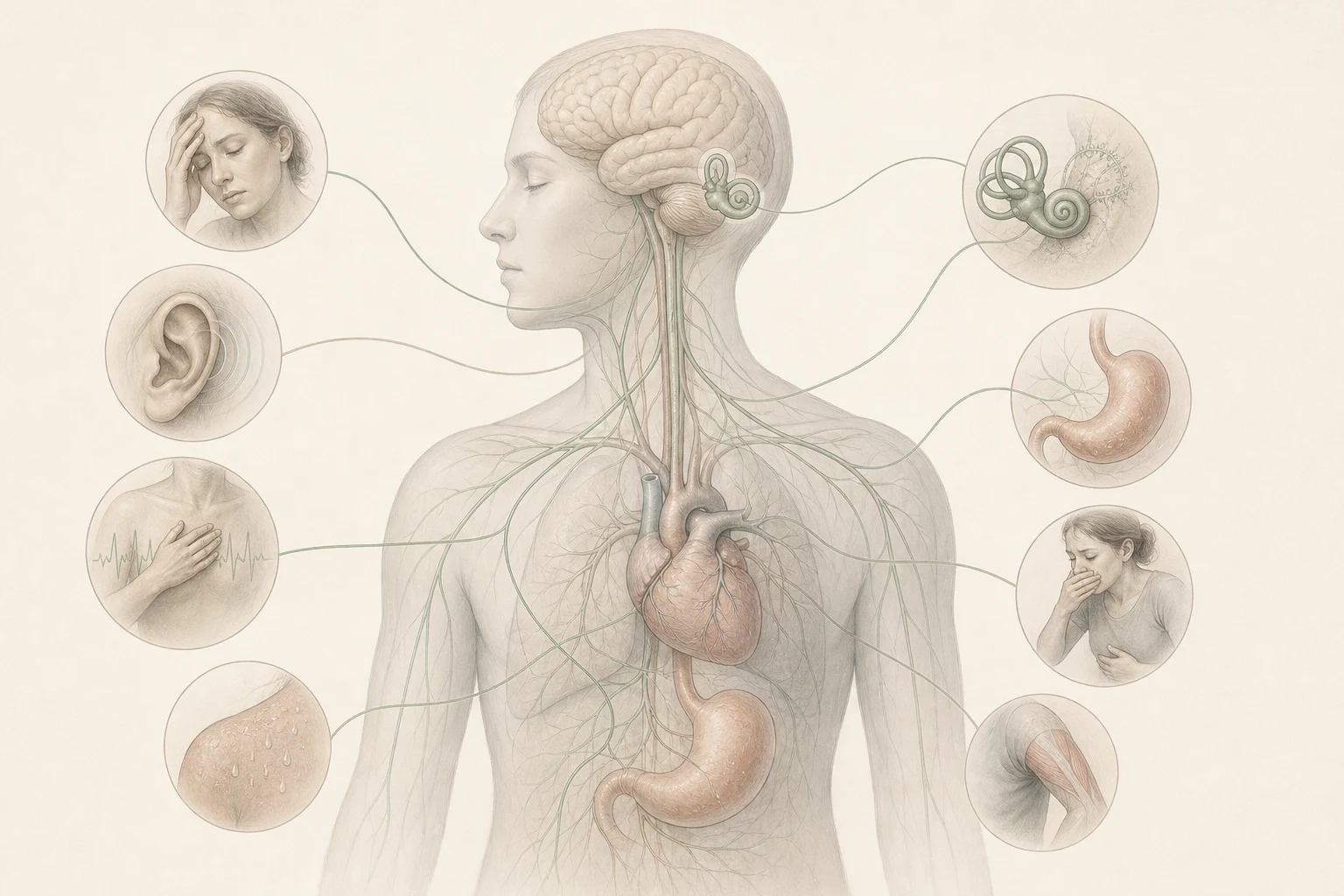
While the systemic response is real, the term 'autonomic nerve' alone does not replace a diagnosis of cardiac, neurological, or endocrine causes.
Photos show daily life scenes where symptoms appear, and explanatory diagrams simplify how reactions in the ears, balance, nerves, and the entire body are connected. They do not represent an individual's diagnostic or treatment results.If you have had these experiences
If nausea recurs alongside dizziness, headaches, or pulsating sensations, and leads to reduced food intake
When dizziness or headaches begin, nausea may occur, leading to a reduction in water and food intake; in some cases, energy levels do not recover even after the episode ends. We examine the cause of nausea along with intake and recovery issues.
Those who avoid eating before going out because they feel like vomiting whenever they experience dizziness or migraines
When nausea recurs even after checking for gastrointestinal, ear, headache, or medication-related causes
Those who experience recurring nausea and chest tightness (epigastric discomfort) like episodes even after medical tests
When the sequence of dizziness, light sensitivity, pulsating sensations, and nausea repeats in the same order
Those whose fluid intake, food intake, and energy levels do not recover for several days even after nausea subsides
When it takes a long time for food intake and energy levels to recover after symptoms
This is how we approach the medical evaluation
Nausea: The sequence of symptom onset and symptoms to check first
For nausea, pregnancy, infection, medication, abdominal emergencies, and dehydration are checked first. For chronic or recurring symptoms, we distinguish between gastrointestinal, balance, and headache-related causes by analyzing the sequence of food intake, abdominal pain, vertigo, light sensitivity, and pulsating sensations.
Identify the onset of the feeling of wanting to vomit
The primary cause to investigate varies depending on whether it occurs before or after meals, or after head movement, vehicle travel, screen use, or headaches.
Focus on intake and dehydration rather than the frequency of vomiting
Check whether hydration is maintained, if urination has decreased, and if weight and energy levels are dropping.
Observe until the recovery phase of dizziness or migraines
Even if vertigo or pain decreases, track the duration during which nausea prevents eating or moving.
Reasons why it may not heal easily
Body conditions that coincide on days when nausea persists
For nausea, pregnancy, infection, medication, abdominal emergencies, and dehydration are checked first. For chronic or recurring symptoms, we distinguish between gastrointestinal, balance, and headache-related causes by analyzing the sequence of food intake, abdominal pain, vertigo, light sensitivity, and pulsating sensations.
Examine the relationship with meals
Note whether it starts during fasting, at the first spoonful, or after a meal, and whether abdominal pain or bloating accompanies it.
Examine the relationship with head movement, vehicles, or screens
If it starts with vertigo after movement, continue to check for symptoms related to the sense of balance.
Check for headaches and sensory hypersensitivity
Record whether nausea occurs after becoming sensitive to light, sound, or smells.

Placing the test name, date of administration, first symptom, accompanying symptoms, and recovery time on the same timeline allows for a more continuous flow of questions during multiple medical evaluations.
Conceptual reference · NICE: Shared decision making · AHRQ: Questions Are the AnswerTest and lifestyle records
How to place test results and lifestyle records on a single timeline
Please let us know the symptoms before and after nausea, and how well you have been able to maintain water and food intake.
Dehydration, abdominal emergencies, and medication-related causes are evaluated first
If you are unable to maintain water intake or experience progressing pain, those evaluations take priority.
Select the starting trigger among diet, ears, or headaches
Determine the sequence of symptoms before and after nausea.
Adjust based on the range of eating and movement
Compare fluid intake, the amount of a single meal, movement, and recovery time.
Korean herbal medicine pattern identification for nausea
If nausea repeatedly follows dizziness, headaches, or throbbing, and leads to reduced food intake, Korean herbal medicine treatment distinguishes between four categories
Whether nausea follows vertigoMigraineand the sequence connecting to diet and medication is categorized. After ruling out urgent causes, the herbal medicine prescription reflects changes in digestion, body heat, and sleep.
When nausea occurs after dizziness and head heaviness
We observe if nausea lasts longer after head, vehicle, or screen movement. We ask about bloating, phlegm, edema, and a feeling of heaviness in the body. This helps recovery from nausea following phlegm-fluid (Dameum) and vestibular stimulation.
When the solar plexus feels blocked and nausea rises with burping or reflux
We check if nausea is central after post-meal fullness, burping, or heartburn. We verify eating speed, constipation, and abdominal bloating. This reduces the reaction where the stomach fails to push contents down and instead pushes them upward.
When throbbing and stomach stiffness occur due to tension
We observe if nausea and solar plexus tightness increase before meetings or going out. We ask about chest tightness, sighing, insomnia, and headaches. This regulates both tension-induced autonomic responses and the upward surge of the stomach.
Changes to monitor during treatment
Daily activities you wish to recover before addressing nausea
While maintaining cause-specific evaluations, we aim to recover the fluid intake, diet, and range of movement reduced by nausea, and shorten the recovery time from exhaustion after an attack.
Starting point relative to diet, head movement, screens, vehicles, and headaches
In the first consultation, these criteria serve as the current starting point. While maintaining cause-specific evaluations, we aim to recover the fluid intake, diet, and range of movement reduced by nausea, and shorten the recovery time from exhaustion after an attack.
Vomiting, fluid intake, urine, weight changes, and medications
Treatment priorities are adjusted by comparing changes over several days rather than a single good day. While maintaining cause-specific evaluations, we aim to recover the fluid intake, diet, and range of movement reduced by nausea, and shorten the recovery time from exhaustion after an attack.
Sequence of dizziness, light sensitivity, pulsating, and cold sweats
The direction of subsequent care is determined based on the lifestyle the patient wishes to return to. While maintaining evaluation by cause, we focus on recovering fluid intake, diet, and range of movement reduced by nausea, and reducing the recovery time from exhaustion following an attack.
At the crossroads of test results and recovery speed
If nausea repeatedly follows dizziness, headache, or pulsating, and leads to reduced food intake, Korean herbal medicine treatment distinguishes between four categories
We categorize the sequence in which nausea relates to vertigo, migraines, diet, and medication. After identifying the urgent cause, changes in digestion, body heat, and sleep are reflected in the Korean herbal medicine prescription.
Pattern identification is not about grouping various symptoms into a single autonomic nerve issue. While maintaining the causes to be verified in ear, balance, nerve, and heart evaluations, we identify the axis where dizziness, tinnitus, headache, facial movement, sleep, digestion, body heat, and heart rate actually change together to adjust the priority of the prescription.
When nausea occurs after dizziness and head heaviness
- Changes observed in the head, ears, and face
- We check if nausea persists after head movement, vehicle travel, or screen use.
- Changes observed throughout the body
- We ask about bloating, phlegm, edema, and a feeling of heaviness in the body.
- Prescription Priority
- We help the recovery from nausea following phlegm-fluid (Dameum) and vestibular stimulation.
When the solar plexus feels blocked and nausea rises with burping or reflux
- Changes observed in the head, ears, and face
- We check if nausea is the primary symptom following post-meal fullness, burping, or heartburn.
- Changes observed throughout the body
- We check eating speed, constipation, and abdominal bloating.
- Prescription Priority
- We reduce the reaction where the stomach fails to move contents downward and instead pushes them upward.
When pulsating occurs and the stomach feels tight under tension
- Changes observed in the head, ears, and face
- We check if nausea and tightness in the solar plexus increase before meetings or going out.
- Changes observed throughout the body
- We ask about chest tightness, sighing, insomnia, and headaches.
- Prescription Priority
- We regulate both the tension-induced autonomic response and the upward reflux of the stomach.
When one feels exhausted even after eating a small amount and recovery is slow
- Changes observed in the head, ears, and face
- Even if vomiting is infrequent, we check if appetite and the amount of a single meal continue to decrease.
- Changes observed throughout the body
- We check for loose stools, coldness in the hands and feet, exhaustion, and weight.
- Prescription Priority
- It strengthens the spleen and stomach to help with nutrient intake and recovery of energy.
Order of Prescription Adjustment
- First, we check for dehydration, abdominal emergencies, or medication-related causes.
If you cannot keep fluids down or have progressing pain, those evaluations take priority.
- Identify the starting trigger among meals, ear-related issues, or headaches.
Determine the sequence of symptoms occurring before and after nausea.
- Adjust based on the range of eating and movement.
Compare fluid intake, the amount of a single meal, movement, and recovery time.
- Change one priority at a time and verify through daily functioning
Rather than a nausea score, we look at the amount you can eat and drink, the time you can move without vomiting, and the recovery of energy after discomfort.
Why consider Korean herbal medicine treatment now?
- When nausea recurs even after checking for gastrointestinal, ear, headache, or medication-related causes
- When the sequence of dizziness, light sensitivity, pulsating sensations, and nausea repeats consistently
- When it takes a long time for food intake and energy to recover after symptoms
What is verified in Korean herbal medicine treatment for this condition
- Starting point in relation to meals, head movement, screens, vehicles, or headaches
- Vomiting, fluid intake, urine output, weight changes, and medications taken
- The sequence of dizziness, light sensitivity, pulsating sensations, and cold sweats
Distinguish between heart, bleeding, or abdominal diseases and dehydration
We check chest pain, breathing, abdominal pain, vomit, urine output, and consciousness to ensure necessary emergency care is not delayed.
Align the timing of meals, headaches, dizziness, and medication
We review the start time, meals, movement/posture, headaches, possibility of menstruation or pregnancy, and all medications in a single record.
Track changes in chronic nausea along with treating the cause
While continuing treatment for the identified cause and using antiemetics, Korean herbal medicine treatment tracks how nausea, food intake, sleep, and daily functioning change.
Things to prepare before the consultationIf you prepare the start time of nausea, details on meals, vomiting, diarrhea, abdominal pain, headaches, dizziness, possibility of menstruation or pregnancy, all medications, recent surgeries, chest pain, and urine output, we can discuss the goals of Korean herbal medicine treatment more specifically during your visit.
If new paralysis, slurred speech, gait disturbance, sudden hearing loss, thunderclap headache, chest pain, dyspnea, or fainting occurs, a prompt medical evaluation is required even if previous tests were normal. After ruling out these exceptions, we focus on herbal medicine treatment for chronic, recurrent, and recovery-phase symptoms.
Consult about recurring nauseaFrequently Asked Questions
Frequently Asked Questions about Nausea
What causes nausea every morning?
There are various causes, including the possibility of pregnancy, fasting or reflux, migraines, anxiety, and medications. Check if it recurs in relation to menstruation, meals, headaches, or medication intake.
If I have both a headache and nausea, is it a migraine?
Sensitivity to light and sound along with recurring headaches can appear in migraines, but a diagnosis cannot be confirmed by symptoms alone. Severe headaches experienced for the first time or neurological symptoms require an emergency evaluation first.
What else should I check along with nausea symptoms?
Check for vomiting, diarrhea, abdominal pain, heartburn, headaches with light and sound sensitivity, vertigo, the possibility of menstruation or pregnancy, and the use of new medications. Seek medical evaluation immediately for chest pain, difficulty breathing, vomiting blood, or severe dehydration.
If I feel nauseous after taking a new medication, can I stop taking it?
Do not stop taking it on your own. Inform the prescribing medical staff of the medication name, dosage, start date, and any nausea or vomiting to discuss how to adjust the treatment.
Can I treat only the nausea first with Korean herbal medicine?
Medical evaluation for the underlying cause takes priority in cases of chest pain, dehydration, bleeding, severe abdominal pain, or persistent vomiting during pregnancy. After a differential diagnosis, you may consult on targeting Korean herbal medicine treatment for chronic discomfort.
What should I record when visiting for Korean herbal medicine treatment for nausea?
Please record whether the nausea started first in relation to meals, dizziness, headaches, or medications, as well as the frequency of vomiting and intake amount. Also, prepare information on the possibility of pregnancy and any test results.
Does Korean herbal medicine treatment for nausea replace existing tests or treatments?
Fainting, new chest pain or difficulty breathing, one-sided paralysis, slurred speech, or symptoms that suddenly worsen Tremorrequire a necessary evaluation first. The scope of Korean herbal medicine treatment is determined when symptoms recur even after acute causes have been identified.
Do I need to bring my records again even if the nausea test results were normal?
Seek medical evaluation again if vomiting continues after testing, or if dehydration, weight loss, severe abdominal pain, or new neurological symptoms occur. Please provide the test date and any changes in intake.
How is the progress of Korean herbal medicine treatment for nausea determined?
We do not look at a single symptom score. We compare the frequency and duration of attacks, activities you can perform again, such as sleeping, eating, walking, using screens, or working, and the time it takes to return to your original state after an attack.
Evidence and Update Information
This content was compiled by Korean medicine doctor Choi Yeon-seung based on the official professional materials and disease-specific clinical data below, and was updated on 2026-08-26.
- American Heart Association: Arrhythmia symptoms and monitoringConnection between palpitations, dizziness, fainting and ECG/symptom records
- American Heart Association: Heart attack symptomsEmergency evaluation boundaries for chest pain, shortness of breath, cold sweats, and nausea
- MedlinePlus: Heart palpitationsCommon accompanying symptoms of palpitations and record items to prepare for consultation
- NHS: Feeling sick (nausea)Common situations for nausea and clinical guidance needed for dehydration or progressing symptoms
- NINDS: TremorMaterials explaining the area, situation, neurological evaluation, and treatment scope of tremors
- CDC: Stroke signs and symptomsEmergency criteria for sudden one-sided weakness or speech changes that must be distinguished from tremors or lethargy
- NICE: Transient loss of consciousnessClinical criteria for branching between fainting/near-fainting sensations and cardiac/neurological evaluations
- Johns Hopkins Medicine: POTSDescription of a patient group where heart rate, dizziness, brain fog, and lethargy are linked after postural changes