Symptoms appearing throughout the body
What to Distinguish First When Dizziness, Pulsating, and Cold Sweats Occur Together
If similar episodes recur even after acute causes have been identified, the recovery of the unstable autonomic nervous system, along with posture, diet, sleep, and digestion, can be the target of Korean medicine treatment.
Dizziness and pulsating·When cold sweats occur suddenly, we first determine whether it is a moment where the body failed to maintain blood pressure and heart rate, a problem with heart rhythm, or a reaction to hypoglycemia, hyperventilation, or vestibular stimulation.
The order in which the three symptoms appear is key to identifying the cause
If your vision blurs and you feel weak after standing up, followed by an increased heart rate, it may be a compensatory reaction to dropped blood pressure and circulation. Conversely, if your heart suddenly begins to beat irregularly, followed by dizziness and cold sweats, we first examine the heart rhythm. If you experience hand tremors, hunger, and cold sweats accompanied by a mental fog after fasting or exercise, we also check for issues with blood glucose and energy supply.
In cases where strong rotational vertigo and nausea in the ear occur first, followed by a racing heart and cold sweats, it may be a Autonomic nerves reaction to vestibular stimulation. The meaning of these same three symptoms changes depending on whether the throbbing or the dizziness occurs first.
If symptoms occur when standing and resolve when lying down, we examine the orthostatic response
If symptoms begin after standing up from a lying or sitting position, worsen when standing for a long time, in hot places, during showers, or after meals, and subside upon sitting or lying down again, it is close to the pattern of orthostatic dizziness. In such cases, we examine not only orthostatic hypotension, where blood pressure drops, but also postural orthostatic tachycardia syndrome (POTS), where the heart rate increases excessively, and vasovagal reactions.
Dehydration, anemia, bleeding, recent weight loss, and medications such as blood pressure drugs and diuretics can worsen the orthostatic response. These causes must be verified before labeling it as an autonomic nervous system problem to ensure the treatment sequence is correct.
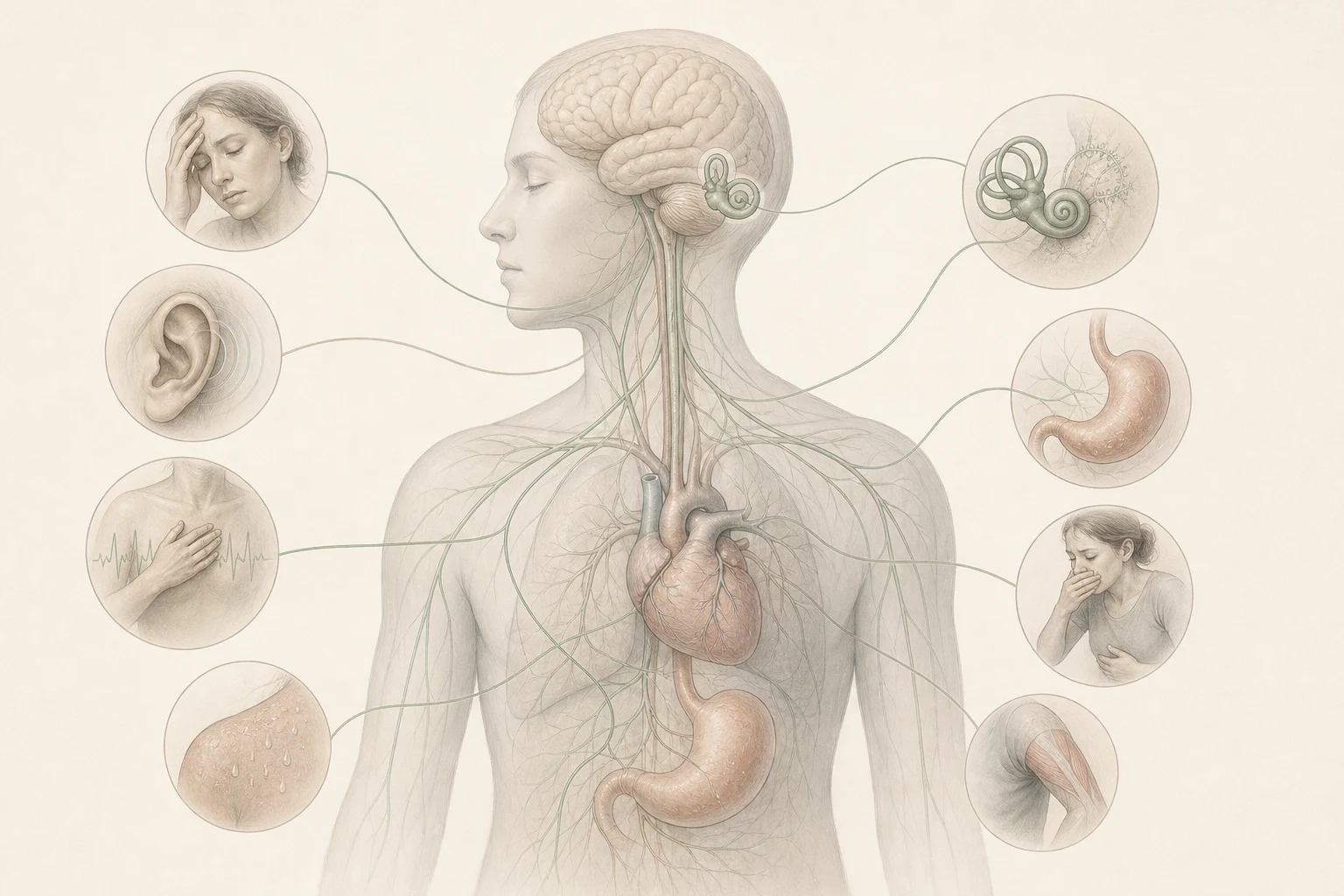
While the systemic response is real, the term 'autonomic nerve' alone does not replace a diagnosis of cardiac, neurological, or endocrine causes.
For seizures during exercise and actual fainting, we first examine the heart rhythm
Electrocardiograms (ECG) and cardiac evaluations are the priority if you experience sudden throbbing and chest pain during exercise, faint while sitting with an irregular pulse, or have a family history of sudden cardiac death at a young age. If seizures are short and occur sporadically, a single normal ECG may not fully explain the rhythm at the time of the event.
Do not wait until your next appointment if new chest pain, shortness of breath, fainting, one-sided weakness, or speech changes occur. These safety standards are not intended to cause fear, but are the first step in properly treating recurring functional or autonomic nervous system symptoms after ruling out acute causes.
If seizures recur even after tests are completed, we examine the body's recovery capacity
Some people experience recurring similar seizures after overwork, lack of sleep, fasting, menstruation, or after meals, even when no acute problems with the heart, brain, or blood glucose are found. In these cases, we do not look at blood pressure and heart rate in isolation, but examine how easily the autonomic nervous system response collapses on days when digestion is blocked, heat rises upward, or energy levels are low.
The underlying reason why the body cannot maintain circulation differs depending on whether you feel exhausted and mentally foggy for hours after a seizure, whether symptoms worsen in warm places or when standing for long periods, or whether loose stools, nausea, and loss of appetite accompany the symptoms. These differences serve as the actual basis for prescriptions in Korean medicine treatment.
Korean medicine treatment focuses on creating a stable foundation rather than simply suppressing the heart rate
At Baekrokdam, we prescribe Korean herbal medicine by categorizing patients into: Qi and Blood Deficiency (easy fatigue, dizziness upon standing, and cold sweats), Phlegm-Fluid (blocked solar plexus, nausea, and head heaviness), Qi Stagnation/Rising Heat (heat rising to the chest and face after stress with a spiking heart rate), and Yin Deficiency (throbbing chest and dryness of body fluids after lack of sleep).
Acupuncture treatment reduces tension in the chest and diaphragm and lowers excessive sympathetic nervous system responses, helping the body adapt to changes in posture. Korean herbal medicine treatment focuses on reinforcing the energy, digestion, absorption, and sleep recovery that support circulation, aiming to reduce the frequency of simultaneous dizziness, throbbing, and cold sweats triggered by small stimuli.
Do not try to endure during a seizure; instead, expand your recovery range in daily life
If you feel as though you might faint, sit or lie down immediately to prevent a fall, and if possible, raise your legs to recover. If heat, dehydration, or prolonged fasting are clear triggers, ensure adequate hydration and regular meals; however, those with fluid or salt restrictions due to heart or kidney disease should follow their existing guidelines. Trying to endure by standing for a long time to fight the symptoms is not recovery training.
When the treatment is effective, the spike in heart rate upon standing decreases, the time required to lie down after an episode shortens, and you can return to daily activities you previously avoided, such as showering, commuting, or grocery shopping. Rather than a single number, Baekrokdam views recovery as the body stably adapting to changes in posture, diet, and activity.
Dizziness, throbbing, and cold sweats have different meanings regarding heart rhythm, orthostatic response, blood sugar, and vestibular stimulation depending on the sequence and posture; once acute causes are ruled out, the recovery of the autonomic nervous system and general energy can be addressed together through Korean medicine treatment.
Evidence and Update Information
This content was organized by Korean medicine doctor Choi Yeon-seung based on the materials below and was updated on 2026-08-31.
- American Heart Association: Arrhythmia symptoms and monitoringConnection between palpitations, dizziness, fainting and ECG/symptom records
- American Heart Association: Heart attack symptomsEmergency evaluation boundaries for chest pain, shortness of breath, cold sweats, and nausea
- MedlinePlus: Heart palpitationsCommon accompanying symptoms of palpitations and record items to prepare for consultation
- NHS: Feeling sick (nausea)Common situations for nausea and clinical guidance needed for dehydration or progressing symptoms
- NINDS: TremorMaterials explaining the area, situation, neurological evaluation, and treatment scope of tremors
- CDC: Stroke signs and symptomsEmergency criteria for sudden one-sided weakness or speech changes that must be distinguished from tremors or lethargy
- NICE: Transient loss of consciousnessClinical criteria for branching between fainting/near-fainting sensations and cardiac/neurological evaluations
- Johns Hopkins Medicine: POTSDescription of a patient group where heart rate, dizziness, brain fog, and lethargy are linked after postural changes
- NIDCD: Balance DisordersSensations of dizziness and imbalance: Basic pathways for equilibrium system evaluation and rehabilitation
- Bárány Society: Classification of vestibular symptomsCriteria for verbally distinguishing between vertigo, non-rotational dizziness, and symptoms triggered by posture or vision